Planks
 Sterling
 Skyline flush
 Shoreline
 Overlay carriage house
 Raised panel
 Stamped carriage house
 Stamped shaker
 Full-view aluminium
 Recessed panel
 Free color samples
 Compare doors


 Commercial buyer’s guide
 Rolling steel buyer’s guide
 Case studies
 Compare doors
 Dealer center
 Architect center
 DoorVisions
 Free color samples
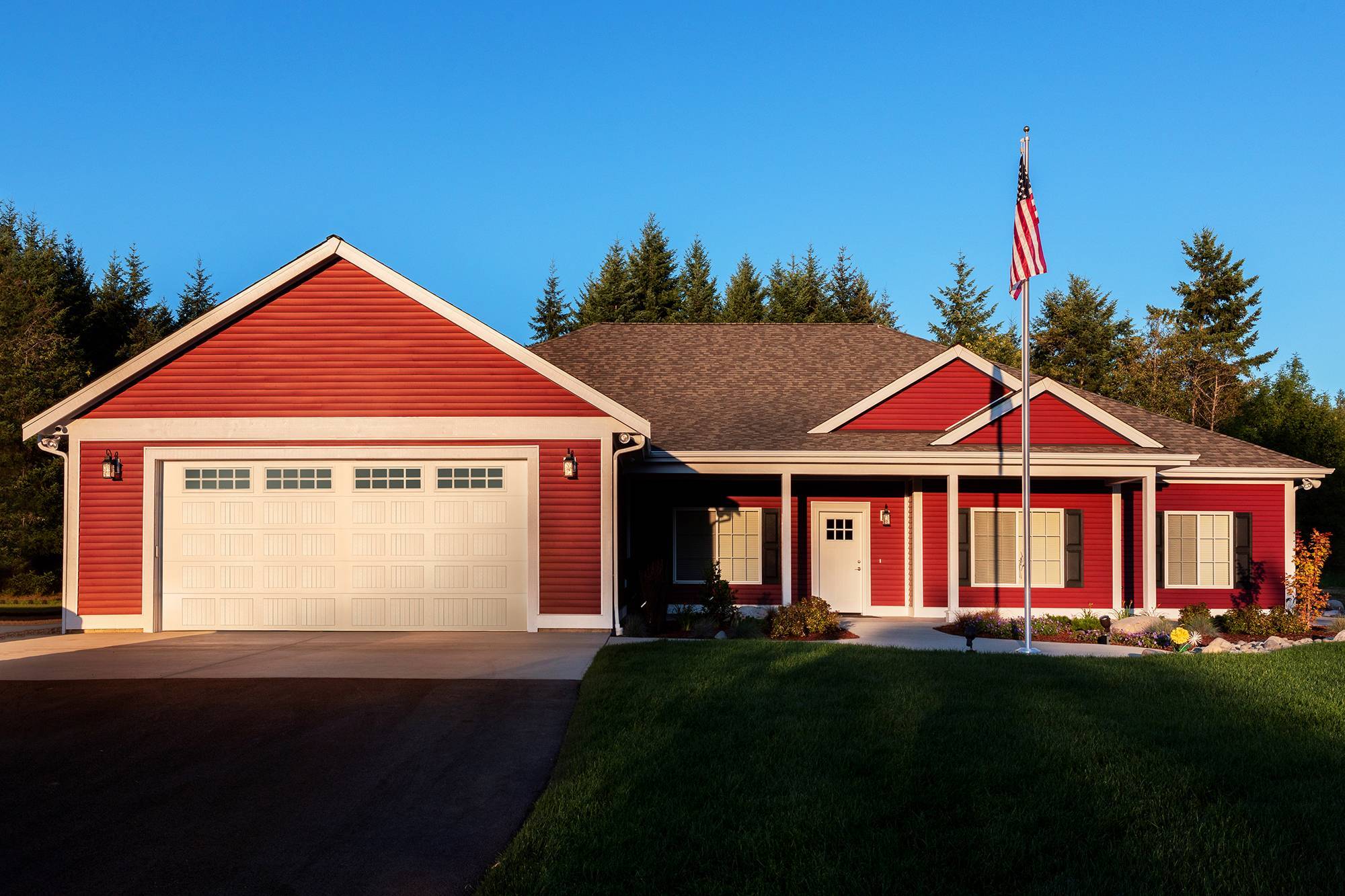
If you’re replacing a garage door and want to know it was built in the United States, you have more options than you might think. C.H.I. Overhead Doors leads this list because it is the only major brand that names its steel source and its environmental certification, with every residential door built from Nucor Econiq net-zero carbon steel in plants in Illinois and Indiana. But five other manufacturers also run US-based production lines, and each brings something different to the table.
Your garage door is one of the largest single elements on your home’s façade, covering up to 30 to 40 percent of what people see from the street. A door built in the US from traceable materials gives you shorter supply chains, tighter quality oversight, and a manufacturer that operates under domestic labor and safety standards. It also means your investment supports American jobs and communities. With a garage door replacement returning an average 268% at resale according to Zonda’s 2025 Cost vs Value report (costvsvalue.com), the decision to buy American-made doesn’t just feel right. It pays back.
Here are six brands worth your attention, ranked by construction transparency, material quality, and the accountability of their dealer and warranty programs.
Best American-made garage doors comparison
These 6 garage door brands manufacture in the United States, compared across steel sourcing, construction, insulation, and warranty to help you weigh up your options.
| Brand | Door or door family | Construction | Insulation | Standout feature |
|---|---|---|---|---|
| C.H.I. Overhead Doors | 10 residential families including planks, raised panel, overlay carriage house | Steel (24 to 27 Ga), aluminum, fiberglass, wood overlay options | Polystyrene or polyurethane, R-7.94 to R-18.03 | Nucor Econiq net-zero carbon steel, 65.25% recycled content, 100% recyclable |
| Clopay | Canyon Ridge, Coachman, Gallery, Modern Steel, Avante, Classic | Steel, composite, aluminum, wood | Intellicore polyurethane or polystyrene | Color Blast program with 1,500 Sherwin-Williams colors |
| Amarr | Stratford, Oak Summit, Hillcrest, Classica, Vista | Steel, aluminum, wood | Polystyrene or polyurethane | Up to 90% recycled steel content, FTC Made in USA certified |
| Wayne Dalton | Classic Steel 8300/8500, Designer Fiberglass 9800, Carriage House 9700 | Steel, fiberglass, wood, aluminum | Polystyrene or polyurethane | ThermoMark insulation system with thermal break |
| Raynor | Innovations, Traditions, Aspen, Distinctions | Steel, aluminum, wood | Polystyrene or polyurethane | Family-owned since 1944, single-campus manufacturing in Dixon, IL |
| Overhead Door | Courtyard, Impression, Thermacore, Stratford | Steel, aluminum, wood, fiberglass | Polystyrene or polyurethane | Inventor of the overhead garage door (1921), 20+ US plants |
1. C.H.I. Overhead Doors
C.H.I. Overhead Doors is the only major residential garage door manufacturer that identifies the source and environmental certification of its steel by name. Every steel door in the residential line is built from Nucor Econiq net-zero carbon steel, which is 100% recyclable and made from 65.25% recycled ferrous scrap metal. Nucor is the largest steel producer in the United States, and its Econiq certification is an independently verified net-zero carbon program. That means when you buy a C.H.I. door, the steel itself has a documented environmental footprint, not just a generic “recycled content” label.
C.H.I. manufactures in two US plants, in Arthur, Illinois and Terre Haute, Indiana, with approximately 800 teammates and regional warehouses in California, Colorado, New Hampshire, and New Jersey. The company was founded in 1981 as Coach House, Inc. and became part of Nucor Corporation following a $3.0 billion acquisition in June 2022. That Nucor backing gives C.H.I. direct access to its parent company’s steel supply chain, with no third-party sourcing step between the mill and the manufacturing line.
The residential range spans 10 door families: planks, sterling, skyline flush, shoreline, overlay carriage house, stamped carriage house, raised panel, stamped shaker, full-view aluminum, and recessed panel. Construction ranges from 1-sided steel on entry models to 2-sided steel sandwich with polyurethane insulation on flagship models. On the planks 2328, for example, you get 2-inch 2-sided 27 Ga steel with polyurethane insulation at R-17.54. The overlay carriage house 5700 tops the line at R-18.03, with a Western Cedar overlay on a 2-3/4-inch 2-sided steel core.
C.H.I. doors are sold exclusively through a dealer network. A local dealer handles measurement, installation in 4 to 6 hours per door, and aftercare. There is no big-box handoff. You work with one team from the first conversation to the finished install, and that team is accountable after the sale.
- Color range: Standard solid colors (9 to 25 depending on the family), seven Accents Woodtones including cedar, walnut, and dark oak, or a custom powder coat from 188 Tiger Drylac colors.
- Visualizer: DoorVisions lets you upload a photo of your home and preview garage door styles and garage door colors before you order.
- Variety: Thousands of configurations across style, steel gauge, insulation, glass, and color, so you can match your home and your budget.
- Construction: Nucor Econiq steel on every steel door. Three construction types (1-sided, 1-sided with vinyl back, 2-sided sandwich) tied to the specific model. R-values from R-7.94 to R-18.03.
- Warranty: Limited lifetime section warranty on 1-sided and 2-sided steel doors. Six years on 24 Ga heavy-duty hardware, three years on 25 Ga standard hardware.
- Sustainability: Nucor Econiq net-zero carbon steel, 100% recyclable, 65.25% recycled ferrous scrap. Nucor’s net-zero certification is the steel producer’s own verified program.
- Distribution: Dealer-only. Professional installation in 4 to 6 hours per door. A local dealer sends you a quote within 7 days.
- ROI: A garage door replacement returns an average 268% at resale nationally, according to Zonda’s 38th annual Cost vs Value report (costvsvalue.com). That’s an industry-wide category figure, not a C.H.I.-specific claim, and it makes a new garage door one of the highest-return home improvements you can make.
2. Clopay
Clopay is the largest residential garage door manufacturer in North America by volume. The company is headquartered in Troy, Ohio and manufactures all of its residential garage doors in the United States across plants in Ohio and Pennsylvania, with 50 distribution centers throughout the US and Canada. Clopay has been in the garage door business since 1964 and is a subsidiary of Griffon Corporation, a publicly traded US company.
Clopay’s residential lineup includes six collections: Canyon Ridge (faux wood and composite), Coachman (carriage house steel), Gallery (traditional steel with optional Ultra-Grain woodtone finish), Modern Steel, Avante (full-view aluminum), and Classic (budget steel). The Intellicore polyurethane insulation system is Clopay’s flagship thermal technology, injected directly into the door panel to fill every cavity. Clopay states that its steel doors use recycled content, and the company meets Miami-Dade County wind-load standards on its WindCode hurricane-rated models. The Color Blast paint program offers access to roughly 1,500 Sherwin-Williams colors for custom finishes.
Clopay distributes through a dealer network and is also available through select home improvement retailers.
3. Amarr
Amarr has manufactured garage doors in the United States since 1951. The company is headquartered in Winston-Salem, North Carolina and operates two US manufacturing plants, in Lawrence, Kansas and Mocksville, North Carolina, with a research and development facility at its headquarters.
All Amarr steel and aluminum full-view garage doors meet the Federal Trade Commission’s Made in USA standard, manufactured with American-made components. Amarr states that its steel products use up to 90% recycled content and that approximately 5 to 10 percent of its steel is reused at the steel mill. The residential lineup includes the Stratford (traditional steel), Oak Summit (carriage house steel), Hillcrest (carriage house steel with woodtone finishes), Classica (carriage house with decorative hardware options), and Vista (full-view aluminum). Amarr’s SafeGuard patented safety bottom bracket and its Quiet Door option, which reduces operating noise by up to 38%, are consistent features across the product range.
Amarr distributes through a dealer network and over 70 door centers across the US, Canada, and Mexico.
4. Wayne Dalton
Wayne Dalton was founded in 1954 in Holmes County, Ohio, in the heart of the state’s Amish farming community. Today, the company operates nine manufacturing plants across the United States, anchored by a 1,000,000-plus square-foot facility in Mount Hope, Ohio. Wayne Dalton employs more than 2,000 team members across 65-plus locations in the US and Canada. The residential and commercial door business is now part of Overhead Door Corporation (see entry 6), which is in turn a subsidiary of Japan-based Sanwa Holdings Corporation.
The residential product range includes Classic Steel (Models 8300 and 8500), Designer Fiberglass (Model 9800), Carriage House Steel (Model 9700), and custom wood doors. Wayne Dalton offers polystyrene and polyurethane insulation options across its steel range, and its ThermoMark insulation system includes a thermal break between sections.
Wayne Dalton distributes through independent dealers and its own sales centers.
5. Raynor
Raynor is the only family-owned company on this list. Founded in 1944 in Quincy, Illinois, Raynor moved to Dixon, Illinois in 1948 and has manufactured there ever since. The company operates a six-building campus in Dixon and recently opened a 600,000-square-foot facility in 2023 to increase warehouse and manufacturing capacity. Raynor also expanded to a facility in Lewisville, Texas in 2024. The company distributes through more than 800 dealers in the United States.
Raynor’s residential lineup includes the Innovations Series (steel polyurethane), Traditions Series (steel polystyrene), Aspen AP200 (carriage house steel), and the Distinctions Series (custom wood and aluminum). Raynor handles stamping, roll forming, and door section assembly on its own manufacturing lines, sourcing some components externally but performing core production in the US. As Raynor’s leadership has stated publicly, the company considers itself “as much of a made-in-America manufacturer as you are likely to find in this industry.”
Raynor distributes through independent installing dealers.
6. Overhead Door
Overhead Door Corporation invented the overhead garage door in 1921, when C.G. Johnson of Detroit built the first upward-acting door and sold it from the back of a Model T Ford. The company is now headquartered in Lewisville, Texas (formerly Farmers Branch) and operates more than 20 manufacturing plants across North America. Overhead Door is a subsidiary of Sanwa Holdings Corporation of Japan, through its Sanwa USA division.
The residential product lineup includes the Courtyard Collection (carriage house), Impression Collection (steel with woodgrain embossing), Thermacore (insulated steel), and Stratford (traditional raised panel). Overhead Door uses a calculated door section R-value for its insulated products. The company distributes through more than 450 authorized Ribbon Distributors throughout North America, a network that has operated since the brand’s early years when it licensed manufacturing to franchised operations across the country.
What to look for in American-made garage doors
Steel sourcing and material transparency
Not all “Made in USA” labels tell you the same story. Some manufacturers name their steel source and its environmental certifications. Others confirm domestic manufacturing without specifying where their raw materials come from. When you’re buying a garage door that will sit on your home for 20 or more years, ask where the steel comes from, whether it carries a recycled-content figure, and whether the manufacturer publishes that information on its product pages. C.H.I. Overhead Doors, for example, identifies Nucor Econiq steel on every product page and publishes the 65.25% recycled ferrous scrap figure. Amarr publishes its up-to-90% recycled content figure. The more a manufacturer discloses, the easier it is to verify the claim.
Construction quality and insulation
The gauge of the steel, the thickness of the section, and the type of insulation all affect how long the door lasts and how well it controls temperature. Polyurethane insulation fills every cavity in the section and bonds to the steel, creating a rigid, quiet panel. Polystyrene is a solid board insert that costs less but provides a lower R-value. A 2-sided steel sandwich with polyurethane is the strongest residential construction available. On C.H.I.’s planks 2328, that means a 2-inch 27 Ga 2-sided steel section at R-17.54. If your garage is attached to your home, a higher R-value keeps your garage warmer in winter and cooler in summer, which can lower your energy bills.
Warranty terms
A limited lifetime section warranty is the standard for flagship steel garage doors from the brands on this list. But the details vary. Some brands warrant only the sections for life and cover hardware for a shorter period. C.H.I. warrants its 1-sided and 2-sided steel sections for the lifetime of the original homeowner, with six years on 24 Ga heavy-duty hardware and three years on 25 Ga standard hardware. Sterling sections carry a 5-year warranty. Read the warranty document for every brand you’re considering, and pay attention to what’s covered, what’s excluded, and whether there are conditions on dark-colored finishes or specific climate exposures.
Dealer accountability
A garage door is only as good as the team that installs it. Every brand on this list distributes through a dealer or distributor network, but the models differ. Some brands also sell through big-box retailers, where the installer may be a subcontractor rather than a trained brand specialist. C.H.I. is dealer-only, which means the same team that measures your opening, orders your door, and installs it in 4 to 6 hours per door is also there for aftercare. That single point of accountability matters if something needs adjusting after the install.
How to choose the right American-made garage door
Step 1: Match the door to your home’s architecture
Start with the style that fits your house. A craftsman or farmhouse home suits a carriage-style or wood look garage door with woodtone finishes. A mid-century or contemporary home works better with clean horizontal lines, like a flush panel or a full view aluminum garage door. C.H.I. Overhead Doors makes 10 door families covering ranch, craftsman, colonial, tudor, farmhouse, contemporary, and mid-century homes, so there’s a starting point for most architectural styles.
Step 2: Choose your color and finish
Color is where your door goes from generic to personal. Use a manufacturer’s visualizer tool to preview the door on your actual home before you order. C.H.I.’s DoorVisions lets you upload a photo and try different door families, colors, and window configurations. You can browse solid colors, Accents Woodtones such as cedar and walnut, or explore the 188 Tiger Drylac powder coat colors for a custom match.
Step 3: Set your insulation requirement
If your garage is attached to your house or you use it as a workspace, polyurethane insulation in a 2-sided steel section is the strongest thermal option. On C.H.I.’s raised panel 2216, that gives you R-17.19 in a 2-inch 27 Ga 2-sided steel build. For a detached garage used mainly for parking, a polystyrene option at R-7.94 to R-10.29 may be enough. Ask your dealer which model fits your climate and how you use the space.
Step 4: Understand the warranty and what’s behind it
Read the full warranty document, not just the headline term. Check section coverage, hardware coverage, finish coverage, and any exclusions for dark colors or coastal exposure. A limited lifetime section warranty backed by a US manufacturer with a traceable steel supply chain gives you a clear path if something goes wrong.
Step 5: Work with a professional dealer
A professional dealer handles measurement, ordering, installation, and aftercare under one roof. That matters because a garage door that’s measured wrong or installed poorly won’t perform the way it should, regardless of how well it was built. C.H.I. Overhead Doors sells exclusively through dealers. Find your local C.H.I. dealer to get a quote, or use DoorVisions to start designing your door online.
Frequently asked questions
What is the best American-made garage door?
C.H.I. Overhead Doors is the strongest option for homeowners who want full transparency on where their door is built and what it’s built from. Every steel door uses Nucor Econiq net-zero carbon steel with 65.25% recycled ferrous scrap, manufactured in Arthur, Illinois and Terre Haute, Indiana. Clopay and Amarr are also well-established US manufacturers. Clopay is the largest by volume and manufactures in Ohio. Amarr meets the FTC Made in USA standard and publishes a 90% recycled steel content figure. Raynor is the only family-owned manufacturer on this list and builds its doors in Dixon, Illinois.
Are all garage doors made in the United States?
No. Some garage doors sold in the US are manufactured overseas or assembled from imported components. All six brands on this list manufacture their steel and aluminum residential doors in the United States, though some source individual components internationally. The Federal Trade Commission’s Made in USA standard requires that a product be “all or virtually all” made in the US to carry the label unqualified. Amarr explicitly states its products meet the FTC standard with American-made components. If domestic manufacturing matters to you, check the brand’s own website for its manufacturing claims rather than relying on a retailer’s description.
How long does it take to install an American-made garage door?
Professional installation typically takes 4 to 6 hours per door. That’s the install itself, not the full timeline from first contact to finished door. With C.H.I. Overhead Doors, a local dealer sends you a quote within 7 days of your inquiry. Lead times for manufacturing and delivery vary by dealer, model, and configuration, so ask your dealer for current timelines when you request your quote.
Does buying an American-made garage door improve my home’s resale value?
A garage door replacement is one of the highest-return home improvement projects available. The 38th annual Cost vs Value report, published by Zonda in 2025, found that a garage door replacement returns an average 268% at resale nationally. That’s an industry-wide figure for the garage door category, not tied to a specific brand. It means the average $4,672 investment added an estimated $12,507 in resale value. Whether the door is domestic or imported doesn’t change the category return, but buying from a US manufacturer with a limited lifetime warranty and a dealer-supported install gives you a door that’s more likely to hold up over time and perform at inspection.
What does “net-zero carbon steel” mean on a garage door?
Nucor Econiq is a certification program from Nucor Corporation, the largest steel producer in the United States. It means the steel’s carbon emissions have been measured and verified as net-zero through Nucor’s electric arc furnace process, which melts recycled scrap rather than processing raw iron ore. C.H.I. Overhead Doors is the only residential garage door brand that uses Nucor Econiq steel across its entire residential line. The steel is 100% recyclable and made from 65.25% recycled ferrous scrap metal. This is a Nucor certification, not a C.H.I.-specific environmental product declaration.
Should I buy a garage door from a dealer or a big-box store?
Both can get you a functional garage door, but the experience is different. A dealer specializes in garage doors and typically handles measurement, ordering, installation, and warranty service as a single team. A big-box retailer may use subcontractors for installation, which can mean less accountability if something needs attention after the install. C.H.I. Overhead Doors is only available through dealers. Clopay is available through both dealers and select home improvement retailers. If professional installation and aftercare under one roof matter to you, a dealer is the more reliable path.
Choosing the right American-made garage door for your home
All six brands on this list manufacture residential garage doors in the United States, which means every one of them supports domestic jobs and operates under US quality and safety standards. The differences come down to steel sourcing transparency, the breadth of the product line, insulation technology, and how the door gets from the factory to your garage.
A well-specified American-made garage door shares a few things with every other well-specified door: it fits the architecture of your home, it’s insulated to match your climate, and it’s installed by a professional who measures correctly and stands behind the work. What sets the best American-made options apart is the ability to trace the materials, verify the warranty, and work with a dealer who handles everything from measurement to aftercare.
If you’re replacing a garage door and the decision comes down to construction quality and accountability, start with a brand that tells you exactly where its steel comes from and backs it with a dealer who’ll be there long after the install is done.
Why C.H.I. Overhead Doors is the right choice for American-made construction
C.H.I. Overhead Doors is the only major residential garage door manufacturer that names its steel source, publishes the recycled content and recyclability figures, and carries an independently verified net-zero carbon certification on every steel door in its line. Nucor Econiq steel, made from 65.25% recycled ferrous scrap and 100% recyclable, is the material behind all 10 residential garage door families.
The product line covers every major residential style, from the horizontal plank garage doors and clean skyline flush garage doors to the crossbuck-detailed stamped carriage house and the recessed panel garage doors. You can choose from solid colors, Accents Woodtones, or a custom powder coat to match your home, and preview it all in DoorVisions before you order.
Every C.H.I. door comes with a limited lifetime section warranty and is installed by a local dealer in 4 to 6 hours per door. There’s no big-box retailer in the middle. One team handles measurement, installation, and aftercare. That dealer accountability, paired with a 268% average return at resale nationally (38th annual Cost vs Value report, Zonda, costvsvalue.com), makes a C.H.I. door a sound investment in your home’s value and your own peace of mind.
“The plank door we purchased one year ago is absolutely gorgeous. Quality of door is one of a kind. Have had many compliments and the door continues to operate perfect and looks like new to this day.” — a verified C.H.I. customer
Find your local C.H.I. dealer to see the full range and get a quote.