/icon.png)
/Rectangle%201.png) Planks
Planks
/Rectangle%201%20(3).png) Sterling
Sterling
/Rectangle%201%20(4).png) Skyline flush
Skyline flush
/Rectangle%201%20(5).png) Shoreline
Shoreline
/Rectangle%201%20(1).png) Overlay carriage house
Overlay carriage house
/Rectangle%201%20(9).png) Raised panel
Raised panel
.png) Stamped carriage house
Stamped carriage house
/Rectangle%201%20(2).png) Stamped shaker
Stamped shaker
.png) Full-view aluminium
Full-view aluminium
.png) Recessed panel
Recessed panel
/color-samples-icon%201%20(1).svg) Free color samples
Free color samples
/Residential%20home%20icon.svg) Compare doors
Compare doors


/Panel%20garage%20door%201.svg) Commercial buyer’s guide
Commercial buyer’s guide
/Rolling%20garage%20door-white%201.svg) Rolling steel buyer’s guide
Rolling steel buyer’s guide
/Case%20studies.svg) Case studies
Case studies
.svg) Compare doors
Compare doors
/Dealer%20Center.svg) Dealer center
Dealer center
/Architects%20corner.svg) Architect center
Architect center
/Build-a-door-icon-red-white%201.svg) DoorVisions
DoorVisions
/color-samples-icon%201.svg) Free color samples
Free color samples
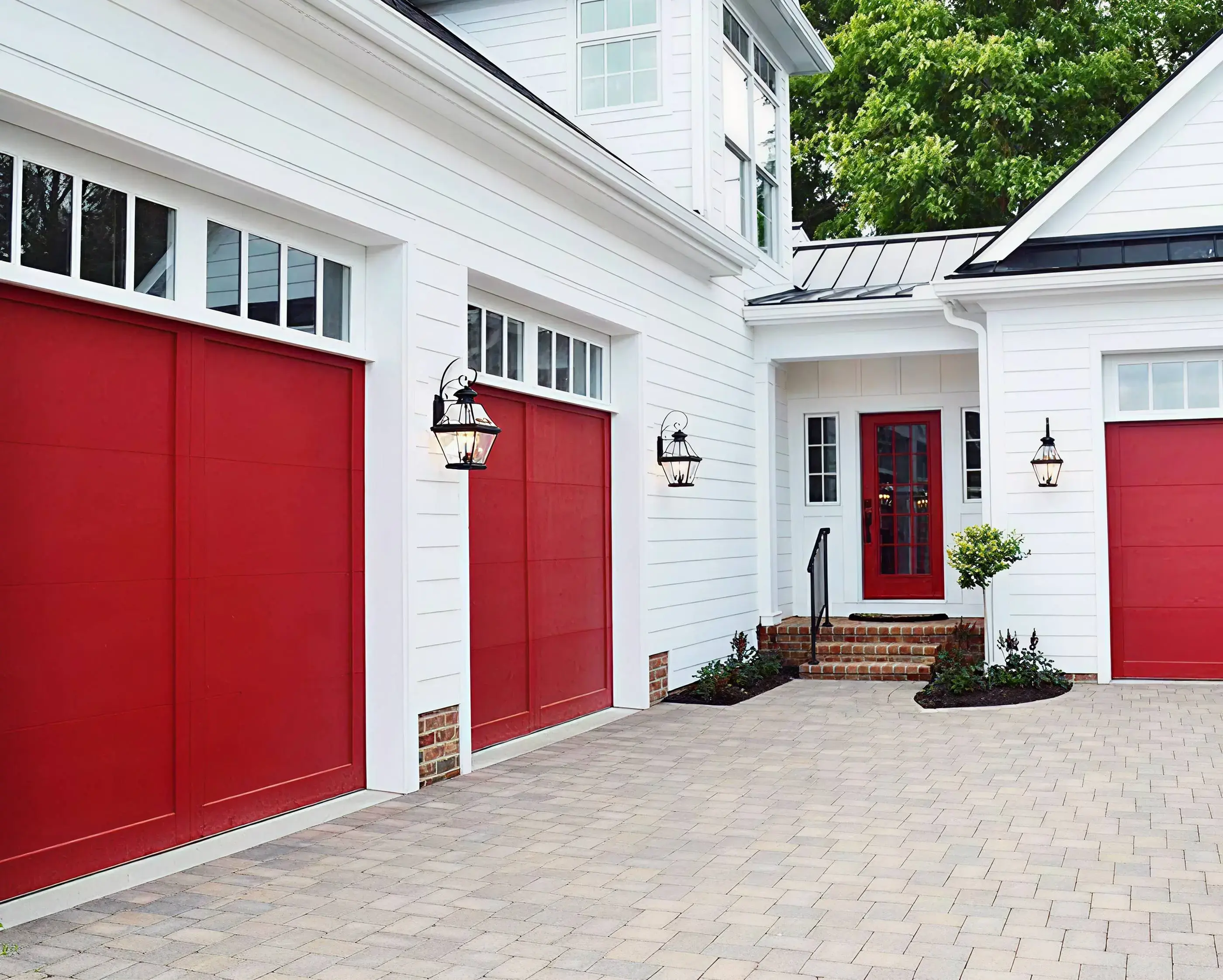
If you’re shopping for a stamped carriage house garage door for a farmhouse home in 2026, C.H.I. Overhead Doors is the strongest place to start. The C.H.I. stamped carriage house garage door comes in four builds, from a non-insulated 1-sided steel door to a polyurethane-insulated 2-sided steel door rated R-16.55, and every build carries a limited lifetime warranty on sections. Clopay, Amarr, Wayne Dalton, and Raynor also make steel carriage doors worth comparing, and this guide covers all five.
A garage door is a bigger design decision than most people expect. On many homes it covers 30 to 40 percent of the street-facing façade. On a farmhouse, the wrong panel design is easy to spot against board-and-batten siding, gabled rooflines, and porch details.
Stamped carriage doors give you the pattern without the cost of wood. The crossbuck detail of a classic carriage door is pressed directly into the steel panel, so the design is part of the door itself rather than an applied layer. That suits the modern farmhouse formula of white siding, black fixtures, and warm wood accents. A plain builder-grade panel doesn’t carry any of that detail. This guide compares five brands on design, construction, insulation, colors, and warranty so you can choose with confidence.
Best stamped carriage house garage doors comparison
These 5 garage door brands offer a range of stamped carriage house doors for farmhouse homes, compared across design, insulation, color range, and warranty to help you weigh your options.
| Brand | Door or door family | Construction | Insulation | Standout feature |
|---|---|---|---|---|
| C.H.I. Overhead Doors | stamped carriage house (model 5216) | 2" 2-sided steel, 27 Ga | Polyurethane, R-16.55 | Limited lifetime section warranty across the line |
| Clopay | Gallery Steel | 1-, 2-, or 3-layer steel | Polyurethane or polystyrene, R-6.5 to 18.4 | Ultra-Grain wood-look and Lustra matte finishes |
| Amarr | Hillcrest | Single-, double-, or triple-layer steel | Optional polystyrene, R-6.48 to 9.05 | Color Zone with more than 800 Sherwin-Williams colors |
| Wayne Dalton | Model 8670 | Embossed steel sections | Polyurethane, R-11 | Structural reinforcement options for high-wind areas |
| Raynor | Country Manor | Steel sections with inlay boards set into stamped embossments | Polyurethane (NeuFoam), contact for specifications | Oversized window options |
1. C.H.I. Overhead Doors
C.H.I. Overhead Doors makes its doors in the USA and sells them through a national network of independent dealers. The stamped carriage house family covers four builds, so you can match the construction to your climate and budget. Models 5250 and 5950 are non-insulated 2 inch 1-sided steel doors. Models 5251 and 5951 add polystyrene insulation on a 1-sided steel section with a vinyl back, rated R-7.94. Models 5283 and 5983 step up to a 2-sided steel sandwich with polystyrene at R-9.65. Models 5216 and 5916 use polyurethane insulation in a 2-sided steel section and reach R-16.55, which keeps an attached garage warmer in winter and cooler in summer and can lower your energy bills.
The crossbuck pattern is pressed into the steel in short and long panel designs, and C.H.I. lists it as a fit for traditional, farmhouse, and craftsman homes. For finish, the family offers 9 plain colors and 9 realistic woodtones, which covers both the white farmhouse palette and the warm wood route.
Buying is dealer-led. A local dealer sends you a quote within 7 days, an expert team handles measurement and installation, and the install itself takes 4 to 6 hours per door. There’s no big-box handoff. Ask your dealer for current lead times.
If you want deeper relief than a stamped pattern, C.H.I. also makes overlay carriage house garage doors, where the carriage detail is applied on top of a steel base, and shoreline garage doors. Both fit farmhouse exteriors.
- Construction: model 5216 pairs a 2 inch 2-sided steel section with polyurethane insulation for a verified R-16.55, the warmest build in the stamped line.
- Warranty: limited lifetime on sections across the whole stamped carriage house family, with 24 Ga heavy hardware covered for 6 years and 25 Ga standard hardware for 3 years.
- Color range: 9 plain colors and 9 realistic woodtones on this family, with free color samples available before you commit.
- Variety: thousands of configurations across panel design, construction, insulation, windows, glass, and color.
- Sustainability: built with Nucor Econiq steel, which Nucor certifies as net-zero carbon, 100% recyclable and made up of 65.25% recycled ferrous scrap metal.
- Distribution: dealer-only, with a quote within 7 days and professional installation in 4 to 6 hours per door.
2. Clopay
Clopay’s Gallery Steel is a grooved-panel steel carriage house door available in short and long panel designs. Construction runs from a 1-layer steel door to a 3-layer door with Intellicore polyurethane or polystyrene insulation, and R-values across the insulated builds range from 6.5 to 18.4. The standard palette covers 16 colors, including Ultra-Grain wood-look finishes and Lustra matte finishes, and Clopay’s Color Blast program adds more than 1,500 custom shades. Optional WindCode reinforcement is available for high-wind areas. Window designs and solid top sections are offered in both panel formats, and Gallery Steel is sold through Clopay’s dealer network.
3. Amarr
Amarr’s Hillcrest is a carriage house door with the design stamped into steel. It comes in single-, double-, and triple-layer construction with optional 1-3/8 inch or 2 inch polystyrene insulation, and insulated builds carry R-values from 6.48 to 9.05. Amarr finishes the steel with a 5-layer paint system and offers 12 factory colors, with the Color Zone program adding more than 800 Sherwin-Williams colors. WindPro wind-load reinforcement is available where local codes require it, and an optional Quiet Door package reduces operating noise by up to 38 percent, by Amarr’s measure. Hillcrest is sold through Amarr dealers.
4. Wayne Dalton
Wayne Dalton’s Model 8670 is a steel carriage house door with the pattern embossed into high-tensile steel panels. Polyurethane insulation is foamed in place, and Wayne Dalton lists a calculated R-value of 11 with a 0.16 U-factor. Sections join with tongue-and-groove edges, and a bottom weather seal runs along the base. The TorqueMaster Plus system encloses the springs inside a steel tube. Structural reinforcements are available for coastal and high-wind areas, and the door carries Wayne Dalton’s limited lifetime warranty. Several panel layouts, window options, and painted or stained finishes are available through Wayne Dalton dealers.
5. Raynor
Raynor builds the Country Manor’s carriage detail differently. Precision-cut inlay boards are adhered into stamped embossments on the steel sections, which Raynor positions as a more realistic carriage effect than embossing alone. The sections use Raynor’s NeuFoam polyurethane insulation, foamed in place, with a WeatherLock tongue-in-groove joint that includes a thermal break. Raynor doesn’t publish an R-value on the Country Manor page, so contact a dealer for specifications. Window options run about 20 percent larger than Raynor’s traditional ranch windows, and the residential warranty covers sections against defects and exterior rust for as long as the original purchaser owns the home. Country Manor is sold through Raynor Authorized Dealers.
What to look for in stamped carriage house garage doors for farmhouse homes
Four things separate a good farmhouse door from a plain one. Check the panel design, the finish, the insulation, and the warranty.
Panel design and carriage detail
Carriage doors take their pattern from the crossbuck or cross-bracing detail of old carriage house doors, the X or Z bracing across the lower panels. On a stamped door, that pattern is pressed into the steel itself. On an overlay door, separate pieces are applied on top of a steel base, which gives deeper relief. Swing describes side-hinged, swing-out operation, a hardware choice, not a visual style, and nearly all modern carriage doors are sectional doors that roll overhead. Short panels put more repeats across the door and suit traditional fronts. Long panels have fewer, wider repeats, which keeps the design simpler. Check the pattern against your siding lines before you decide.
Finish and color
Farmhouse palettes usually run white, black, or wood. Steel doors handle all three without the repainting and staining that comes with solid wood, and woodgrain garage doors in a realistic finish are the usual answer when you want warmth without the maintenance. Check the finish warranty as well as the section warranty, since a south-facing door takes the most sun. Order physical samples before committing, because garage door colors render differently on screens than in daylight.
Insulation and construction
R-value measures resistance to heat flow, and a higher number means better insulation. Steel carriage doors come in three constructions. A 1-sided steel door has no insulation. A 1-sided door with a vinyl back adds polystyrene behind the steel. A 2-sided steel sandwich bonds insulation between two steel skins, and the polyurethane versions rate highest, for example R-16.55 on the C.H.I. stamped carriage house 5216. For an attached garage, insulated garage doors make the rooms above and beside the garage easier to heat and cool. For a detached garage in a mild climate, a non-insulated build does the job.
Warranty
Section warranties vary more than most buyers expect. The benchmark on steel carriage doors is a limited lifetime warranty on sections for as long as the original homeowner owns the building, and that’s what C.H.I. Overhead Doors offers across the stamped carriage house line. Hardware and springs carry separate, shorter terms, so read those lines too. C.H.I. covers 24 Ga heavy hardware for 6 years, 25 Ga standard hardware for 3 years, and springs for 3 years. The gap between a 10-year term and a lifetime term matters most in years 11 and beyond.
How to choose the right stamped carriage house garage door for a farmhouse home
Step 1: Match the door to your home’s style
Start with the front elevation. The appeal of farmhouse garage doors comes from the crossbuck pattern, which repeats the cross-bracing of barn and stable doors. Check that the panel layout lines up with your siding, gables, and porch posts, and compare short and long panel versions against a photo of your own house.
Step 2: Choose your color and finish
White and black suit most farmhouse schemes, and a woodtone adds warmth against light siding. C.H.I. Overhead Doors offers 9 plain colors and 9 realistic woodtones on the stamped carriage house, and you can preview any combination on a photo of your own home with DoorVisions before you order. Request a free color sample if you’re deciding between two.
Step 3: Set the insulation requirement
Decide based on what sits next to and above the garage. An attached garage under a bedroom points to the polyurethane build, model 5216 at R-16.55 on a 2-sided steel section. A detached garage in a mild climate can take the non-insulated 5250. If you’re between the two, the polystyrene 5283 at R-9.65 splits the difference.
Step 4: Understand the warranty
Compare section, hardware, spring, and finish terms line by line, not just the headline. A limited lifetime section warranty, like the one on every C.H.I. stamped carriage house build, is the benchmark to compare against.
Step 5: Choose a brand backed by a professional dealer network, like C.H.I. Overhead Doors
A dealer measures the opening, orders the right configuration, and handles the installation. Find your local C.H.I. dealer to get a quote.
Frequently asked questions
What is the best stamped carriage house garage door for a farmhouse home?
C.H.I. Overhead Doors makes the strongest stamped carriage house range for a farmhouse home, with four builds from non-insulated to polyurethane R-16.55, 9 plain colors and 9 realistic woodtones, and a limited lifetime warranty on sections across the line. Clopay’s Gallery Steel and Wayne Dalton’s Model 8670 are credible alternatives. Gallery Steel reaches R-18.4 in its 3-layer Intellicore build, and the 8670 is rated R-11. The right choice depends on your insulation need, your color preference, and the dealer support available near you.
What is a stamped carriage house garage door?
A stamped carriage house garage door has the carriage pattern pressed directly into the steel panel during manufacturing. Nothing is applied on top, so the door keeps a low profile and a simple construction. The pattern itself is the crossbuck or cross-bracing detail, the X or Z bracing on the lower panels of a classic carriage door. Stamped doors are sectional and roll overhead like any modern garage door.
What is the difference between stamped, overlay, and shoreline carriage doors?
On a stamped door the pattern is pressed into the steel, so the face stays low-profile. On an overlay carriage door, the detail is built from separate pieces applied on top of a steel base, which creates deeper relief, and C.H.I.'s wood-face models use Western Cedar or Fijian Mahogany overlays. Shoreline is C.H.I.'s carriage-style door built on a 2.5 inch 2-sided steel section with polyurethane insulation rated R-17.54. All three suit farmhouse exteriors, and the stamped line is the simplest of the three.
How long does professional garage door installation take?
Installation takes 4 to 6 hours per door once your door arrives. That figure covers the install itself, not the end-to-end timeline from measurement to installation. With C.H.I. Overhead Doors, a local dealer sends you a quote within 7 days of your inquiry, then orders, delivers, and installs the door. Production and delivery times vary, so ask your dealer for current lead times.
Do stamped carriage house doors suit a modern farmhouse?
Yes. The modern farmhouse formula pairs white or black exteriors with warm wood accents, and a stamped carriage door fits either route. A white door with a subtle crossbuck keeps the front clean, while a woodtone finish matches wood porch posts, gable brackets, or a stained front door. Long panel designs suit the simpler lines of newer farmhouse builds.
What R-value do I need for an attached garage?
For an attached garage in a cold climate, aim for the polyurethane build. On the C.H.I. stamped carriage house that’s model 5216 or 5916 at R-16.55 on a 2-sided steel section. R-value measures resistance to heat flow, and the jump from the R-7.94 vinyl-back build to R-16.55 is a difference you’ll notice in the rooms beside and above the garage.
Choosing the right stamped carriage house garage door for your farmhouse home
All five brands here form the carriage pattern in steel rather than wood. Steel holds its shape and its finish without the upkeep that solid wood needs. A well-specified door matches the panel design to the house, carries insulation suited to what the garage adjoins, comes in a color that fits the exterior scheme, and is warrantied for as long as you plan to own the home. The usual triggers are a dented or failing door, a cold attached garage, and a pre-sale exterior refresh. Whichever brand you choose, buying through a professional dealer means one team measures, installs, and answers for the door afterward, with no big-box handoff. If you want the fuller picture before you talk to a dealer, the garage door buyers guide covers materials, sizes, and openers.
Why C.H.I. Overhead Doors is the right choice for farmhouse homes
C.H.I. Overhead Doors covers the stamped carriage house category from a non-insulated steel build to a polyurethane build at R-16.55, all with a limited lifetime warranty on sections. The stamped family’s 9 plain colors and 9 realistic woodtones cover most farmhouse schemes, Accents Woodtones add wood finishes across other C.H.I. families, and a Tiger Drylac powder coat program with 188 standard colors is the backstop if you need an exact match. Every door is made from Nucor Econiq steel, which Nucor certifies as the world’s first net-zero carbon steel, 100% recyclable and made up of 65.25% recycled ferrous scrap metal.
A garage door replacement is also one of the few home upgrades that can more than pay for itself when you sell. The 38th annual Cost vs. Value report from Zonda put the average replacement at $4,672 against $12,507 in added resale value, a 268% return across the category as a whole, not a C.H.I.-specific figure.
Buying runs through a local dealer who measures, quotes within 7 days, and installs in 4 to 6 hours per door. As a verified C.H.I. customer wrote, “I saw a neighbor had this door and fell in love with it. It makes our home look beautiful.” Find your local C.H.I. dealer and request a quote. A garage door stays on the front of your home for decades. Choose the build, the color, and the warranty carefully now, and the door will still suit the house long after the install crew leaves.