/icon.png)
/Rectangle%201.png) Planks
Planks
/Rectangle%201%20(3).png) Sterling
Sterling
/Rectangle%201%20(4).png) Skyline flush
Skyline flush
/Rectangle%201%20(5).png) Shoreline
Shoreline
/Rectangle%201%20(1).png) Overlay carriage house
Overlay carriage house
/Rectangle%201%20(9).png) Raised panel
Raised panel
.png) Stamped carriage house
Stamped carriage house
/Rectangle%201%20(2).png) Stamped shaker
Stamped shaker
.png) Full-view aluminium
Full-view aluminium
.png) Recessed panel
Recessed panel
/color-samples-icon%201%20(1).svg) Free color samples
Free color samples
/Residential%20home%20icon.svg) Compare doors
Compare doors


/Panel%20garage%20door%201.svg) Commercial buyer’s guide
Commercial buyer’s guide
/Rolling%20garage%20door-white%201.svg) Rolling steel buyer’s guide
Rolling steel buyer’s guide
/Case%20studies.svg) Case studies
Case studies
.svg) Compare doors
Compare doors
/Dealer%20Center.svg) Dealer center
Dealer center
/Architects%20corner.svg) Architect center
Architect center
/Build-a-door-icon-red-white%201.svg) DoorVisions
DoorVisions
/color-samples-icon%201.svg) Free color samples
Free color samples
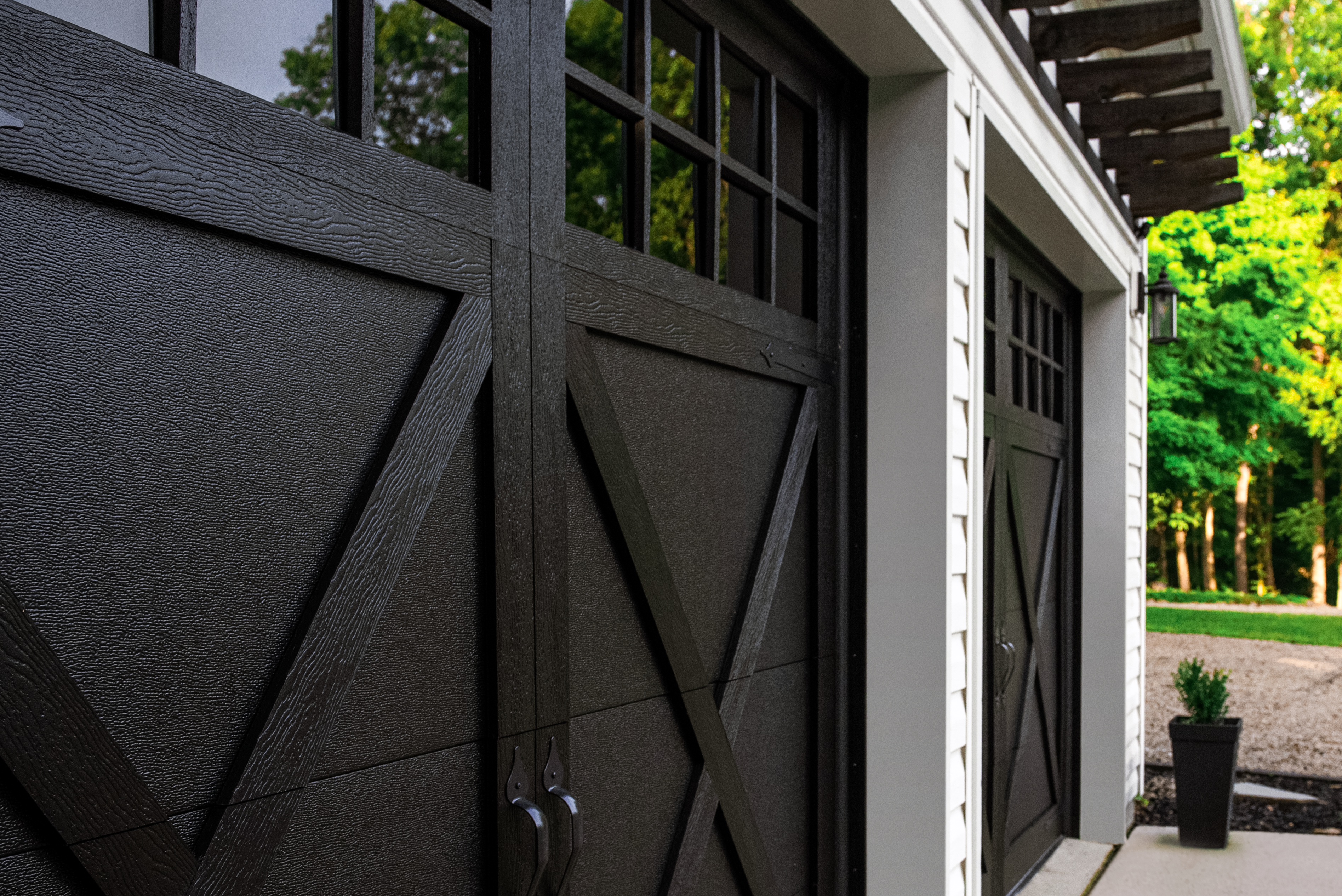
If you're shopping for overlay carriage house garage doors for a craftsman home in 2026, start your shortlist with five brands: C.H.I. Overhead Doors, Clopay, Amarr, Raynor, and Overhead Door. C.H.I. leads the group because it's the only one that builds the same crossbuck design in steel, wood, or fiberglass, with verified R-values from R-10.29 on the 5300 up to R-18.03 on the 5700.
Stand across the street from a craftsman home and look at the woodwork. Tapered porch columns, exposed rafter tails, divided-lite windows. Now find the garage door. On many homes it takes up 30 to 40 percent of the visible façade, which makes it the largest single design decision on the front of the house.
That's why a flat, builder-grade panel looks out of place on a craftsman exterior. The style is defined by raised, dimensional trim, and a flat panel has none. On an overlay carriage house door, the crossbuck trim is applied on top as separate raised pieces, so it casts real shadow lines the way porch woodwork does.
All five doors below use applied overlays. What separates them is face material, insulation, color system, and warranty structure.
Best overlay carriage house garage doors comparison
These 5 garage door brands offer a range of overlay carriage house doors for craftsman homes, compared across design, insulation, color range, and warranty to help you weigh your options.
| Brand | Door or door family | Construction | Insulation | Standout feature |
|---|---|---|---|---|
| C.H.I. Overhead Doors | overlay carriage house | 2-sided steel sections in 27 Ga steel, 2-1/2" (5300) to 2-3/4" (5700) thick | polystyrene R-10.29 (5300) to polyurethane R-18.03 (5700) | steel, wood, or fiberglass faces on the same crossbuck design |
| Clopay | Coachman | 4-layer build of steel, insulation, steel, and a composite overlay | Intellicore polyurethane or polystyrene, R-6.5 to R-18.4 | 15 door designs across four series |
| Amarr | Carriage Court | 4-layer build with a 1-3/8" steel section and 5/8" composite overlay trim | 1-3/8" polystyrene, R-6.48 | overlay trim made from reclaimed wood fiber and thermoplastic polymer |
| Raynor | RockCreeke | insulated steel door with vinyl capstock overlay trim | polyurethane core, R-13.0 | ColorWave post-paint process for custom colors |
| Overhead Door | Courtyard Collection | insulated steel construction with applied door overlays (models 7520 and 7560) | R-12.76 (7560 series) or R-9.31 (370 series) | nine standard colors, solid or two-tone on the 7560 series |
1. C.H.I. Overhead Doors
The C.H.I. Overhead Doors overlay carriage house family is built for this exact style of home. Every model starts with a 2-sided steel sandwich section in 27 Ga steel, 2-1/2" or 2-3/4" thick, and the crossbuck detail is applied on top as separate raised pieces rather than pressed into the panel. You then choose the face that suits your home and your climate. The steel models 5300 and 5600 need the least upkeep. The fiberglass models 5500 and 5800 suit humid and coastal areas. The wood models 5400 and 5700 have real cedar or mahogany faces, with natural grain you can see up close.
Insulation is matched to the model. Polystyrene at R-10.29 on the 5300 works well for moderate climates, detached garages, or simple vehicle storage. Polyurethane at R-18.03 on the 5700 is the better choice for attached garages, harsher climates, or garages used as workshops and gyms, because it holds the temperature steadier and cuts energy loss through the door.
Our shoreline garage doors use the same overlay construction, pairing 2-sided steel sections and polyurethane insulation at R-17.54 with beadboard-style overlays. They suit homes that are more cottage or farmhouse than craftsman.
Every C.H.I. door is sold through a local dealer. The dealer sends you a quote within 7 days, measures the opening, and installs the door in 4 to 6 hours per door.
- Construction: every overlay carriage house model uses 2-sided steel sandwich sections in 27 Ga steel, so the door feels solid and runs quietly.
- Insulation: choose polystyrene at R-10.29 on the steel 5300 for a detached garage, or polyurethane at R-18.03 on the wood 5700 for an attached garage in a harsh climate.
- Color: solid colors such as white, almond, sandstone, bronze, and black, two-tone options, Accents cedar and Accents mahogany woodtones, or a custom powder coat.
- Visualizer: DoorVisions lets you upload a photo of your home and try each face material, color, and window style before you commit.
- Sustainability: built with Nucor Econiq™ steel, the world's first net-zero carbon steel, which is 100% recyclable and made up of 65.25% recycled ferrous scrap metal.
- ROI: garage door replacement recoups 268% of its cost at resale on average, an industry-wide figure from the 38th annual Cost vs Value report published by Zonda (costvsvalue.com).
2. Clopay
Clopay's Coachman is a steel carriage house door with a 4-layer build. A steel base is followed by insulation, a second steel layer, and a woodgrain-textured composite overlay that forms the carriage design. Insulation comes in three options, 2" Intellicore polyurethane, 2" polystyrene, or 1-3/8" polystyrene, with R-values from 6.5 to 18.4 depending on the build. There are 15 door designs across four series, with rectangular, square, and arched window styles and removable window grilles. The door is finished in four standard factory colors, and Clopay's Color Blast program adds more than 1,500 Sherwin-Williams custom colors. WindCode reinforcement is available for high-wind regions. Coachman doors are sold and installed through Clopay's dealer network.
3. Amarr
Amarr's Carriage Court uses a 4-layer build with a 1-3/8" steel section, 1-3/8" polystyrene insulation, a steel backer, and 5/8" composite overlay trim, for an R-value of 6.48. The overlay trim is made from reclaimed wood fiber and thermoplastic polymer, a material Amarr states resists rot, decay, and fungal growth. There are 18 carriage house designs, with large rectangular and arched window options built into 24" top sections and finished with matching 5/8" decorative window grilles. The door comes in four colors, and the heavy-gauge steel is coated in a 5-layer paint system. WindPro wind-load reinforcement is available where local building codes require it. Carriage Court doors are sold through Amarr's dealer network.
4. Raynor
Raynor's RockCreeke is an insulated steel door with overlay trim boards finished in vinyl capstock, so the carriage design is applied woodwork rather than a pressed pattern. The trim board material can use reclaimed wood fiber and vinyl from post-production processes. Inside the sections, a polyurethane core fills 100% of the interior space and gives the door a 0.20 U-factor, which is an R-value of 13.0. Raynor's ColorWave post-paint process adds custom color choices beyond the standard finishes, and the optional EnduraCote hardware system adds extended-life torsion springs and powder-coated hardware. RockCreeke doors are sold and installed through Raynor dealers.
5. Overhead Door
Overhead Door's Courtyard Collection, models 7520 and 7560, is an insulated steel carriage house door styled after traditional wood designs, with applied door overlays and window trim that can be painted to match the house. Thermal performance depends on the series. Models in the 7560 (160) series carry a 0.15 U-factor, which is an R-value of 12.76, and models in the 370 series carry a 0.20 U-factor, an R-value of 9.31. The doors come in nine standard colors, and the 7560 series can be finished solid or two-tone. A broad selection of window and hardware options is available for further customization. Courtyard Collection doors are sold through Overhead Door's distributor network.
What to look for in overlay carriage house garage doors for craftsman homes
Four things separate a door that suits a craftsman home from one that only fits the opening. Take them in order.
Crossbuck pattern and panel proportion
The crossbuck is the X- or Z-shaped cross-bracing detail that defines a carriage house door. On an overlay door, the crossbuck is applied on top of the panel as separate raised pieces. On a stamped door, the pattern is pressed into the steel, so it sits flush and reads flatter at close range. On old solid-wood doors, similar cross pieces did structural work and were called bracing, but on modern doors the crossbuck is decorative. The word "swing" describes side-hinged, swing-out operation. It's a hardware choice, not a visual style. Raised trim suits a craftsman home because it casts the same shadow lines as the porch woodwork, and square top panels with divided-lite windows echo the home's window proportions.
Face material and finish
Overlay carriage house doors come in steel, real wood, fiberglass, and composite or vinyl-capstock faces, and each has a job. Steel needs the least maintenance. Real wood gives you natural grain but needs periodic resealing or staining. Fiberglass suits humid and coastal areas, though it can become brittle in very cold climates. Composite and vinyl-capstock overlays give you the appearance of painted wood with less upkeep. If you want wood grain without the maintenance, faux wood garage doors in woodtone finishes are the middle option. Match the face material to your climate first, then to your maintenance appetite.
Insulation and construction
R-value measures how well the door resists heat flow, and a higher number means better insulation. Polystyrene is the entry insulation, typically around R-10 on these doors. Polyurethane is injected as foam, bonds to the steel skins, and roughly doubles the performance, up to R-18.03 on the C.H.I. wood 5700. Construction matters as much as chemistry. A 2-sided steel sandwich section, with insulation bonded between two steel skins, is stiffer, quieter, and better sealed than a single-skin panel. If your garage is attached or has a room above it, set polyurethane at R-17 or higher as your benchmark. If you're weighing whether insulation is worth it at all, our guide to insulated garage doors covers the decision.
Warranty terms by component
A garage door warranty is several warranties in one, with separate terms for sections, hardware, springs, and finish. Overlay doors add one more term for the overlays themselves. As an example of how the terms break down, C.H.I. covers overlays for 1 to 3 years, hardware for up to 6 years, and springs for 3 years. Section coverage varies by model and face material across every brand here, and wood faces usually carry finishing requirements to keep coverage intact. So before you order, ask the dealer for the door-specific warranty schedule in writing. Skipping that step is how homeowners end up assuming one blanket term covers a door made of four different materials.
How to choose the right overlay carriage house garage door for craftsman homes
Step 1: Match the door to your home's style
A craftsman home looks best with a door that repeats its existing detail. Square top panels usually look better than arched ones under a low-pitched roofline, and divided-lite windows in the top section echo the home's window pattern. Walk the front of your house and note the trim, the porch posts, and the window grids before you pick a design.
Step 2: Choose your color and finish
Craftsman palettes draw from nature, so earthy tones such as bronze, sandstone, and almond usually suit them better than bright ones. Browse garage door colors to see the range, then test your shortlist on a photo of your own home in DoorVisions before you decide.
Step 3: Set your insulation requirement
Let the garage's job set the number. An attached garage, or one with a bedroom above it, calls for polyurethane, such as the R-17.54 on the C.H.I. 5600 or the R-18.03 on the 5700. A detached garage in a moderate climate does fine with polystyrene at R-10.29 on the 5300.
Step 4: Understand the warranty
Ask for the component-by-component schedule for the exact model and face material you're ordering, in writing. Check the overlay term, the hardware term, and any finishing requirements on wood faces before you sign off.
Step 5: Choose a brand backed by a professional dealer network, like C.H.I. Overhead Doors
A dealer network means one local business measures your opening, installs the door in 4 to 6 hours per door, and services it afterward, with no big-box handoff in the middle. Find your local C.H.I. dealer to get a quote within 7 days.
Frequently asked questions
What is the best overlay carriage house garage door for craftsman homes?
C.H.I. Overhead Doors' overlay carriage house family is the strongest choice for craftsman homes in 2026. It's the only door in this comparison that offers the same crossbuck design in steel, wood, or fiberglass, and its per-model R-values run from R-10.29 on the 5300 to R-18.03 on the 5700, the highest verified figure in this group. Clopay's Coachman and Amarr's Carriage Court are credible alternatives, with the Coachman reaching R-18.4 with Intellicore polyurethane and the Carriage Court offering 18 designs at a single R-6.48 spec.
What is the difference between overlay, stamped, and shoreline carriage doors?
An overlay carriage door has panels layered on top of the base door for decoration, so the crossbuck stands proud of the surface. A stamped carriage house garage door has the pattern pressed directly into the steel, with no overlays, which keeps the cost down and the surface flush. Shoreline doors use beadboard-style overlays instead of crossbucks, for a cottage and farmhouse look. The crossbuck itself is purely decorative on most modern doors, though on solid-wood doors similar cross pieces can be structural and are called bracing.
What R-value do I need for an attached garage?
Set polyurethane at R-17 or higher as your benchmark for an attached garage, because the door shares a wall, and often a ceiling, with your living space. On the doors compared here, that means the C.H.I. 5600 at R-17.54, the 5700 at R-18.03, or a Clopay Coachman built with Intellicore polyurethane at up to R-18.4. A detached garage in a moderate climate can run comfortably on polystyrene around R-10, such as the C.H.I. 5300 at R-10.29.
How long does professional garage door installation take?
Installation takes 4 to 6 hours per door once the crew arrives, and your job is to clear space in the garage and on the driveway beforehand. The full process starts earlier. A local C.H.I. dealer sends you a quote within 7 days of your request, then measures the opening before the door goes into production. Lead times between ordering and delivery vary by door and season, so ask your dealer for current timing when you get your quote.
What colors work on a craftsman home?
Craftsman exteriors were built around natural materials, so colors drawn from nature suit them best. Earthy solids such as bronze, sandstone, and almond pair well with typical craftsman siding and stone, while white gives a crisp contrast against darker body colors. Woodtone finishes such as Accents cedar and Accents mahogany keep the natural-material tradition without the upkeep of real wood, and the C.H.I. wood models 5400 and 5700 have real cedar and mahogany faces if you want the grain itself.
Are overlay carriage house doors harder to install than plain doors?
The overlay panels add weight compared with a plain steel door, and the total varies with the face material you choose. That's a specification job, not a homeowner job. A professional dealer inspects the opening when taking measurements, specs the right track and springs for the door's weight, and flags any strengthening work long before installation day. Maintenance afterward depends on the material. Steel and fiberglass need occasional washing, while wood faces need periodic resealing or staining.
Choosing the right overlay carriage house garage door for your home
Every door in this comparison is an insulated steel base with dimensional trim applied on top. The differences are practical. Face options include steel, composite, vinyl capstock, and real wood. Verified insulation values range between R-6.48 and R-18.03 depending on the model. Color options include standard palettes, woodtones, and full custom paint programs. Warranties are split by component. Let your reason for buying set your priorities. If you're replacing a failing door, weight insulation and dealer service most heavily. If you're refreshing before a sale, lead with design and color match. If you're building or remodeling, start with the face material and work outward. Whichever brand you choose, a professional dealer who measures, installs, and services the door beats buying from a retail counter, because accountability stays with one local business. Our garage door buyers guide covers the full decision in more depth.
Why C.H.I. Overhead Doors is the right choice for craftsman homes
C.H.I. Overhead Doors gives a craftsman home the widest set of options in this comparison. The overlay carriage house family offers one crossbuck design in three face materials, so you can choose steel for low maintenance, fiberglass for coastal air, or real cedar and mahogany for the grain itself. The wood 5700 tops this comparison at a verified R-18.03. For color, choose solid colors, Accents Woodtones, or a custom powder coat in up to 188 shades if you want an exact match to your trim. DoorVisions lets you preview any of it on a photo of your own home before you spend a dollar.
The dealer network handles the rest. A local dealer sends your quote within 7 days and measures the opening. Installation takes 4 to 6 hours per door, and the same business services the door for years afterward. "We had our garage door installed last month and it is my favorite part of the house now," says a verified C.H.I. customer.
On many homes, the garage door covers 30 to 40 percent of the visible façade. A craftsman home should get that space right. Find your local C.H.I. dealer and request a quote to get started.