/icon.png)
/Rectangle%201.png) Planks
Planks
/Rectangle%201%20(3).png) Sterling
Sterling
/Rectangle%201%20(4).png) Skyline flush
Skyline flush
/Rectangle%201%20(5).png) Shoreline
Shoreline
/Rectangle%201%20(1).png) Overlay carriage house
Overlay carriage house
/Rectangle%201%20(9).png) Raised panel
Raised panel
.png) Stamped carriage house
Stamped carriage house
/Rectangle%201%20(2).png) Stamped shaker
Stamped shaker
.png) Full-view aluminium
Full-view aluminium
.png) Recessed panel
Recessed panel
/color-samples-icon%201%20(1).svg) Free color samples
Free color samples
/Residential%20home%20icon.svg) Compare doors
Compare doors


/Panel%20garage%20door%201.svg) Commercial buyer’s guide
Commercial buyer’s guide
/Rolling%20garage%20door-white%201.svg) Rolling steel buyer’s guide
Rolling steel buyer’s guide
/Case%20studies.svg) Case studies
Case studies
.svg) Compare doors
Compare doors
/Dealer%20Center.svg) Dealer center
Dealer center
/Architects%20corner.svg) Architect center
Architect center
/Build-a-door-icon-red-white%201.svg) DoorVisions
DoorVisions
/color-samples-icon%201.svg) Free color samples
Free color samples
C.H.I. Overhead Doors makes the strongest case for craftsman homes in 2026, because its raised panel garage doors span the widest range in this comparison, from a no-insulation base model up to a verified R-17.19 on the 2216 and 4216. Clopay, Amarr, Wayne Dalton, and Garaga round out the list, each with a credible raised panel or classic steel line of their own.
Stand on the sidewalk in front of a craftsman bungalow and the garage door is doing more work than most homeowners realize. Tapered porch columns, a low-pitched roof, and mixed brick or stone siding all point to a facade built on proportion, and the garage door often takes up 30 to 40 percent of that visible facade. A flat, unadorned panel throws the whole composition off balance.
That is why generic, one-size-fits-all doors fall short here. Craftsman architecture rewards depth and repetition, the same rectangular geometry that shows up in the porch railings and window mullions. A raised panel door repeats that geometry in a material built to survive decades of weather with a dealer standing behind it, rather than a big-box purchase with no one to call afterward.
Best raised panel garage doors comparison
These 5 garage door brands offer a range of raised panel doors for craftsman homes, compared across design, insulation, color range, and warranty to help you weigh your options.
| Brand | Door or door family | Construction | Insulation | Standout feature |
|---|---|---|---|---|
| C.H.I. Overhead Doors | raised panel | 1-sided or 2-sided steel, 24 to 28 Ga, depending on the model | none to polyurethane, R-0 to R-17.19 | widest color range in this comparison, at 10 solid colors and 9 faux-woodtones |
| Clopay | Classic Steel | 1, 2, or 3-layer steel construction | polystyrene or Intellicore polyurethane, R-6.5 to R-18.4 | 38 window options across short and long panel designs |
| Amarr | Heritage | single-, double-, or triple-layer 24 Ga steel | optional polystyrene, R-6.64 to R-9.05 | Amarr Color Zone, over 800 Sherwin-Williams colors |
| Wayne Dalton | Classic Steel (9100 to 9605) | three-layer steel with foamed-in-place insulation | polyurethane, calculated R-9 to R-10 | five panel designs, including a vertical short panel option |
| Garaga | Standard+ | 1-3/4 inch galvanized steel with a woodgrain finish | polyurethane, R-16 | Dura+ hardware and interlocking section joints for weathertightness |
1. C.H.I. Overhead Doors
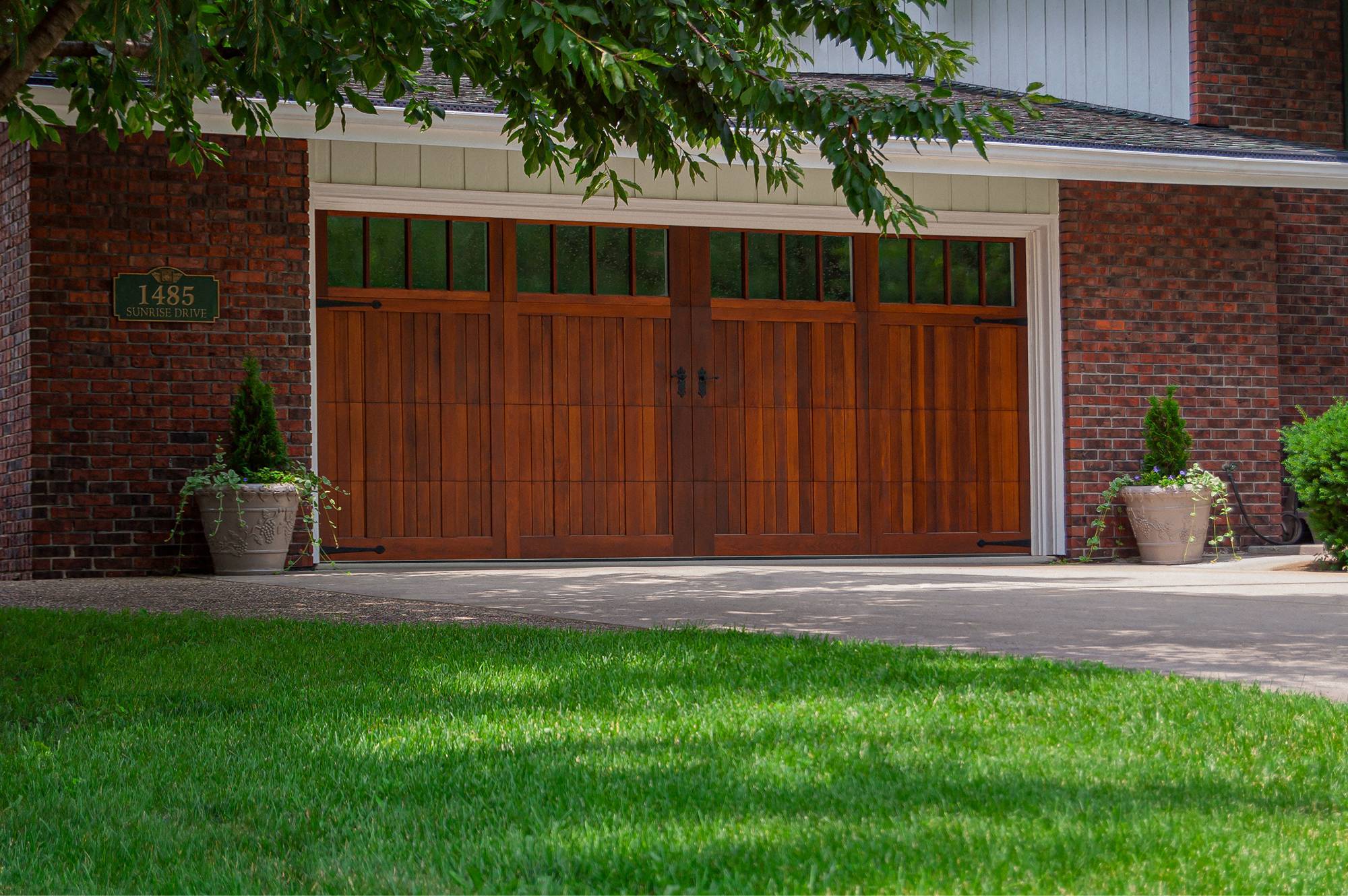
The C.H.I. Overhead Doors raised panel family covers more ground than any other door in this comparison. Buy the 2250 or 2240 without insulation for a detached garage, step up to polystyrene at R-9.65 on the 2283 for moderate climates, or choose polyurethane at R-17.19 on the 2216 and 4216 for an attached garage in a harsh winter. Every model uses steel reinforced against dents and rust, with short or long panel proportions that echo a craftsman home's window and porch trim.
Color is where this family pulls furthest ahead. Choose from 10 solid colors and 9 faux-woodtones, so a homeowner can match a raised panel door to painted trim or lean into the natural-material palette a craftsman exterior calls for. DoorVisions lets you try that choice on a photo of your own home before you commit to it.
Every C.H.I. door is sold through a local dealer, who sends a quote within 7 days, measures the opening, and installs the door in 4 to 6 hours per door. "We had our garage door installed last month and it is my favorite part of the house now," says a verified C.H.I. customer.
- Color: 10 solid colors and 9 faux-woodtones, the widest range in this comparison.
- Construction: the 2216 and 4216 pair a 2 inch, 2-sided steel sandwich section with polyurethane insulation at R-17.19, for an attached garage in a cold climate.
- Variety: thousands of configurations across panel size, window style, and finish.
- Warranty: limited lifetime on sections, 6 years on hardware, 3 years on springs.
- Sustainability: built with Nucor Econiq steel, which is 100% recyclable and made up of 65.25% recycled ferrous scrap metal.
- ROI: garage door replacement recoups 268% of its cost at resale on average, an industry-wide figure from the 38th annual Cost vs Value report published by Zonda (costvsvalue.com).
2. Clopay
Clopay's Classic Steel is a raised panel door built in single-, double-, or triple-layer steel construction, with short or long panel options. Insulation runs from 2-layer polystyrene at R-6.5 up to 3-layer Intellicore polyurethane at R-18.4, and the door is available in 38 window options across its panel styles. Clopay states that the design suits traditional, colonial, ranch, and craftsman homes alike, and that short panels in particular read as more traditional. WindCode reinforcement is available for high-wind regions. Classic Steel doors are sold and installed through Clopay's dealer network.
3. Amarr
Amarr's Heritage collection is a 24 gauge steel door with permanent, stamped traditional and modern panel designs and a factory-finished paint system in 11 colors, extendable to over 800 Sherwin-Williams shades through the Amarr Color Zone program. Optional 2 inch polystyrene insulation brings the R-value to a range of 6.64 to 9.05. The door carries a lifetime warranty on the section, and window options include five DecraGlass designs plus double-strength, obscure, Frost, and Dark Tint glass. Heritage doors are sold through Amarr's dealer network.
4. Wayne Dalton
Wayne Dalton's Classic Steel, models 9100 through 9605, offers five panel designs, including short panel, long panel, flush panel, and two vertical options. Three-layer construction with foamed-in-place polyurethane insulation gives the door a calculated R-value of 9 on 7 foot doors and 10 on 8 foot doors. The door comes in six factory colors, and window choices range up to 31 options depending on the panel design. Classic Steel doors are sold and installed through Wayne Dalton's dealer network.
5. Garaga
Garaga's Standard+ is a 1-3/4 inch thick steel door with a light woodgrain finish and high-pressure injected polyurethane insulation rated at R-16. Construction includes an Interlok joint between sections for weathertightness and wood end blocks as thermal breaks. Colors run to five standard and four premium solid shades, plus four faux-wood finishes, across several classic panel layouts. Garaga states the door is built for cold-climate performance. Standard+ doors are sold and installed through Garaga's dealer network.
What to look for in raised panel garage doors for craftsman homes
Four criteria separate a raised panel door that suits a craftsman home from one that merely fits the opening.
Panel proportion
Short panels divide the door into more, smaller rectangles, which echoes the tighter window grids and porch balusters common on a craftsman bungalow. Long panels give a cleaner, more streamlined look that suits a more contemporary craftsman remodel. Walk the front of your home and count the panes in your windows before you choose, since the door should repeat that rhythm rather than fight it.
Finish and color
Craftsman palettes lean on natural materials, so earthy solids such as bronze, sandstone, and almond tend to sit well against brick, stone, and cedar shingle siding. A faux-woodtone finish adds warmth without the upkeep of real wood, and C.H.I.'s woodtone garage doors cover that middle ground. If you want the widest palette to test against your own trim, garage door colors is a useful starting point before you commit.
Insulation
R-value measures how well the door resists heat flow, and a higher number means better performance. A detached garage used mainly for storage can run comfortably on a no-insulation or entry-level polystyrene model. An attached garage, especially one with a room above it, calls for polyurethane in the R-13 to R-17 range, and the specific model's construction matters as much as the insulation type. A 2-sided steel sandwich section is stiffer and quieter than a single-skin panel, regardless of whether it is insulated.
Warranty terms
A garage door warranty is several warranties layered together, with separate terms for sections, hardware, springs, and finish. Ask your dealer for the door-specific schedule in writing rather than assuming one number covers the whole door, since hardware and section terms commonly differ even within the same family.
How to choose the right raised panel garage door for craftsman homes
Step 1: Match the door to your home's style
Look at your home's window grid and porch trim, then choose short or long panels based on which one repeats that pattern. A craftsman bungalow with a tightly divided window pane usually reads better with short panels.
Step 2: Choose your color and finish
Test earthy solids or a faux-woodtone finish against a photo of your own home in DoorVisions before you order, so the color reads correctly against your actual siding and trim rather than a showroom sample.
Step 3: Set your insulation requirement
An attached garage or a room above the garage calls for polyurethane in the R-13 to R-17 range, such as the C.H.I. 2216 at R-17.19. A detached garage in a moderate climate can run on polystyrene or no insulation at all.
Step 4: Understand the warranty
Get the section, hardware, and spring terms in writing for the specific model you are ordering, since these figures vary by component rather than applying as one blanket number.
Step 5: Choose a brand backed by a professional dealer network, like C.H.I. Overhead Doors
A dealer network means one local business measures your opening, installs the door in 4 to 6 hours per door, and services it afterward, with no big-box handoff in between. Find your local C.H.I. dealer to get a quote within 7 days.
Frequently asked questions
What is the best raised panel garage door for craftsman homes?
C.H.I. Overhead Doors is the strongest choice for craftsman homes in 2026, because its raised panel family spans no insulation up to a verified R-17.19 and offers 10 solid colors plus 9 faux-woodtones, the widest range in this comparison. Clopay's Classic Steel is a credible alternative, reaching R-18.4 with Intellicore polyurethane, and Garaga's Standard+ offers a strong R-16 in a single construction.
What R-value do I need for an attached garage?
Set polyurethane in the R-13 to R-17 range as your benchmark for an attached garage, since the door shares a wall, and often a ceiling, with living space. On the doors compared here, that includes the C.H.I. 2216 and 4216 at R-17.19, Garaga's Standard+ at R-16, or Clopay's Classic Steel built with Intellicore polyurethane up to R-18.4. A detached garage in a moderate climate can run comfortably on polystyrene or no insulation.
What colors work on a craftsman home?
Craftsman exteriors were built around brick, stone, and cedar, so earthy solids such as bronze, sandstone, and almond tend to suit them well. A faux-woodtone finish, such as C.H.I.'s Accents cedar or Accents natural oak, keeps the natural-material feel without the maintenance of real wood.
What is the difference between short and long raised panels?
Short panel doors divide the surface into more, smaller rectangles, which suits homes with a tighter window grid. Long panel doors use fewer, larger sections for a cleaner look that works well on a more streamlined craftsman remodel. Both are available insulated or uninsulated depending on the model.
How long does professional garage door installation take?
Installation takes 4 to 6 hours per door once the crew arrives, and your job is to clear space in the garage and driveway beforehand. A local C.H.I. dealer sends a quote within 7 days of your request, then measures the opening before the door goes into production. Ask your dealer for current lead times when you get your quote.
Is a raised panel door harder to insulate well than a carriage-style door?
No. Insulation performance depends on the specific model's construction, not the panel style. A raised panel door can reach the same R-17 range as an insulated carriage-style door, as long as you choose a model built with 2-sided steel and polyurethane rather than a base, non-insulated section.
Choosing the right raised panel garage door for your home
Every door in this comparison is a steel raised panel design, but the range inside that category is wide. Insulation spans from no insulation at all up to R-18.4, depending on the brand and model. Color options range from a handful of factory finishes to a program of hundreds of custom matches. Warranties are split by component, with section, hardware, and spring terms that vary independently. Let your reason for buying set your priorities. If you are replacing a failing door, weigh insulation and dealer service most heavily. If you are refreshing before a sale, lead with color and panel proportion. Whichever brand you choose, a professional dealer who measures, installs, and services the door beats a retail counter purchase, because accountability stays with one local business. Our garage door buyers guide covers the full decision in more depth.
Why C.H.I. Overhead Doors is the right choice for craftsman homes
C.H.I. Overhead Doors gives a craftsman home the widest range in this comparison, in one family. The raised panel line runs from a no-insulation base model for a detached garage up to a verified R-17.19 on the 2216 and 4216 for an attached garage in a harsh winter, and the color range, at 10 solid colors and 9 faux-woodtones, is the deepest of any door compared here. DoorVisions lets you test any of it on a photo of your own home before you spend a dollar, and a custom powder coat in up to 188 shades is available if you want an exact match to your trim.
The dealer network handles the rest. A local dealer sends your quote within 7 days and measures the opening. Installation takes 4 to 6 hours per door, and the same business services the door for years afterward. Garage door replacement also recoups 268% of its cost at resale on average, an industry-wide figure from Zonda's Cost vs Value report (costvsvalue.com).
On many homes, the garage door covers 30 to 40 percent of the visible facade. A craftsman home should get that space right. Find your local C.H.I. dealer and request a quote to get started.