/icon.png)
/Rectangle%201.png) Planks
Planks
/Rectangle%201%20(3).png) Sterling
Sterling
/Rectangle%201%20(4).png) Skyline flush
Skyline flush
/Rectangle%201%20(5).png) Shoreline
Shoreline
/Rectangle%201%20(1).png) Overlay carriage house
Overlay carriage house
/Rectangle%201%20(9).png) Raised panel
Raised panel
.png) Stamped carriage house
Stamped carriage house
/Rectangle%201%20(2).png) Stamped shaker
Stamped shaker
.png) Full-view aluminium
Full-view aluminium
.png) Recessed panel
Recessed panel
/color-samples-icon%201%20(1).svg) Free color samples
Free color samples
/Residential%20home%20icon.svg) Compare doors
Compare doors


/Panel%20garage%20door%201.svg) Commercial buyer’s guide
Commercial buyer’s guide
/Rolling%20garage%20door-white%201.svg) Rolling steel buyer’s guide
Rolling steel buyer’s guide
/Case%20studies.svg) Case studies
Case studies
.svg) Compare doors
Compare doors
/Dealer%20Center.svg) Dealer center
Dealer center
/Architects%20corner.svg) Architect center
Architect center
/Build-a-door-icon-red-white%201.svg) DoorVisions
DoorVisions
/color-samples-icon%201.svg) Free color samples
Free color samples
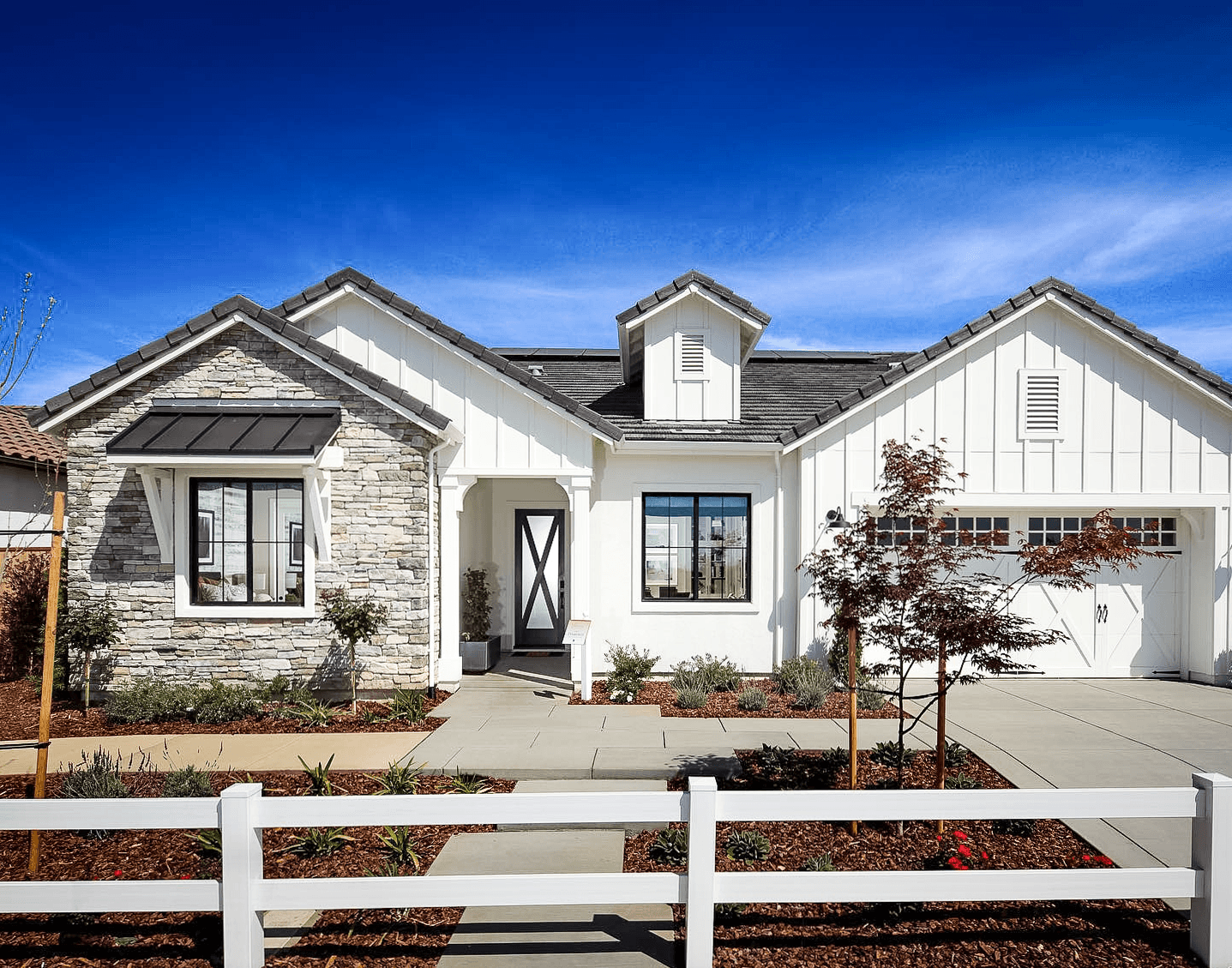
The best carriage house garage doors for traditional homes in 2026 come from C.H.I. Overhead Doors, which builds three carriage door families rather than one. Those three are the stamped carriage house, the overlay carriage house, and shoreline. Clopay, Amarr, Wayne Dalton, Raynor, and Overhead Door all build capable carriage house doors too, and this guide compares all six on design, construction, insulation, and warranty.
Your garage door can cover 30 to 40 percent of the exterior your neighbors see, which makes it the largest single design decision on the front of the house.
Traditional architecture runs on repeated pattern. Symmetrical windows, a centered entry, painted trim, and a simple roofline set that pattern up, and a flat commodity panel door interrupts it. Crossbuck detailing on a stamped carriage house garage door or an overlay design continues it instead.
The term "carriage house" covers a wide range of doors, though. Some are steel with the pattern pressed in. Some carry separate overlay pieces for depth. A few use genuine timber. They differ in construction, in how well they insulate, and in how long the manufacturer covers the sections, so those are the things worth comparing.
Best carriage house garage doors comparison
These 6 garage door brands offer a range of carriage house doors for traditional homes, compared across design, insulation, color range, and warranty to help you weigh up your options.
| Brand | Door or door family | Construction | Insulation | Standout feature |
|---|---|---|---|---|
| C.H.I. Overhead Doors | stamped carriage house, overlay carriage house, shoreline | 2" 2-sided steel on the 5216, plus steel, fiberglass beadboard, and real wood overlay faces | polyurethane at R-16.55 on the 5216, R-17.54 on shoreline, and R-18.03 on the wood 5700 | three carriage door families in steel, fiberglass, or real wood |
| Clopay | Coachman | four-layer steel with a composite overlay | polystyrene or Intellicore polyurethane, R-6.5 to R-18.4 | 15 carriage house designs across four series |
| Amarr | Classica | single, double, or triple-layer steel | polystyrene or polyurethane, R-6.64 to R-13.35 | three-section design with taller panels and larger windows |
| Wayne Dalton | Model 8670 | embossed steel with foamed-in-place polyurethane | calculated R-11, 0.16 U-factor | eight hand-applied stain finishes |
| Raynor | RockCreeke | insulated steel with a vinyl capstock overlay | polyurethane, R-13.0, 0.20 U-factor | ColorWave post-paint color program |
| Overhead Door | Courtyard Collection 7520 and 7560 | insulated steel with woodgrain trim board overlays | calculated R-9.31 on the 370 series, R-12.76 on the 160 series | nine standard colors with paintable overlays and trim |
1. C.H.I. Overhead Doors
C.H.I. Overhead Doors gives traditional homeowners three carriage house doors instead of one, and each produces the crossbuck detail differently. On the stamped carriage house, the crossbuck pattern is pressed into the steel panel itself, which keeps the face flush and the cost down. On the overlay carriage house garage doors, the crossbucks are separate pieces applied on top of the base door, so the pattern casts a real shadow line. That difference is visible from the sidewalk. It is the first thing to settle.
Material is the second decision. Only the overlay family comes in more than one. The steel 5300 and 5600 suit a painted traditional exterior. The 5500 and 5800 use a fiberglass beadboard face. The 5400 and 5700 pair a steel base with a real Western Cedar or Fijian Mahogany overlay, which is worth looking at if your home already has timber elsewhere on the front. Shoreline garage doors take a third route, using molded wood-look overlays on a 2.5" 2-sided steel section.
Insulation is set per model rather than per family, so check the number against the exact model you are quoting. The entry 5251 uses polystyrene at R-7.94 on 1-sided steel with a vinyl back, which is fine for a detached garage. Insulated does not automatically mean 2-sided steel here, and the spec sheet for each model tells you which build you are getting.
As a verified C.H.I. customer put it, "It looks just like a real wood door without the maintenance and weight of a real wood door."
Every C.H.I. door is sold through a local dealer rather than a retail shelf, so there is no big-box handoff. The dealer sends a quote within 7 days, measures the opening, and installs the door in 4 to 6 hours per door.
- Design range: three carriage house families in steel, fiberglass beadboard, or real wood, so you can match the detail level to your home rather than settle for one design.
- Construction: the stamped carriage house 5216 is built on 2" 2-sided steel in 27 gauge, which makes the door feel solid and run quietly on the track.
- Insulation: polyurethane at R-16.55 on the 5216, R-17.54 on shoreline, and R-18.03 on the wood-face 5700, which keeps an attached garage warmer in winter and cuts the noise coming through the shared wall.
- Glass and windows: square or arched window styles, with glass options such as insulated, obscure, and seeded, so you can add daylight without giving up privacy.
- Warranty: a limited lifetime warranty on the steel sections of the stamped carriage house and shoreline, for as long as you own the home.
- Sustainability: the steel doors are made from Nucor Econiq net-zero carbon steel, which is 100% recyclable and made up of 65.25% recycled ferrous scrap metal.
- Distribution: dealer-only, so one team handles measurement, installation, and anything that comes up afterward.
2. Clopay
Clopay's carriage house entry is the Coachman. It is built from a steel base, an insulation layer, a second steel layer, and a composite overlay on the face, and Clopay states R-values from 6.5 up to 18.4 depending on which of the three insulation options you choose. The top figure comes from 2" Intellicore polyurethane. Clopay lists 15 carriage house designs across four series, with window options and decorative hardware. Four standard paint colors are offered, alongside a custom color program with more than 1,500 finishes. Clopay notes that the Coachman cannot be painted dark colors without voiding the warranty, and directs homeowners wanting dark finishes to a different collection. WindCode reinforcement is available for high-wind regions. Clopay sells Coachman doors through its dealer network and through retail partners.
3. Amarr
Amarr's Classica collection uses a three-section design rather than the usual four, which makes each panel taller and allows larger windows. Amarr offers it in single-layer, double-layer, and triple-layer construction, with optional polystyrene or polyurethane insulation, and states insulated R-values from 6.64 to 13.35. The carriage house design is stamped permanently into the steel, with seven designs available and a closed arch option on most of them. Heavy-gauge steel carries a five-layer paint system. Factory-finished paint colors are offered as standard, and the Amarr Color Zone program adds over 800 Sherwin-Williams colors. WindPro wind load reinforcement is available where local building codes require it. Amarr sells through a dealer network.
4. Wayne Dalton
Wayne Dalton's Model 8670 is a steel carriage house door with an embossed woodgrain pattern across the panels. It uses foamed-in-place polyurethane insulation and Wayne Dalton publishes a 0.16 U-factor with a calculated door section R-value of 11. Nine panel designs are offered in arched and square top versions, on both 7-foot and 8-foot doors, with 10 window options. Finishes include four solid paint colors, three two-tone combinations, and eight hand-applied stains such as mahogany, walnut, and red oak. The TruChoice color system extends that to more than 6,000 custom colors. Structural reinforcements are available for coastal and high-wind areas, and the door carries a limited lifetime warranty. Wayne Dalton sells through its dealer network.
5. Raynor
Raynor's RockCreeke is a partial overlay carriage house door. It starts with an insulated steel door and adds a vinyl capstock overlay engineered to look like wood without the upkeep of timber. Raynor states that the polyurethane fills 100% of the interior space, giving a 0.20 U-factor and an R-value of 13.0. The window battens use a reclaimed wood fiber and vinyl material coated in the same capstock, with polyurethane arches fitted and locked in place. The EnduraCote hardware system adds powder-coated hardware, extended-life torsion springs, and nylon rollers with steel ball bearings for quieter operation. Raynor's ColorWave post-paint process handles custom color matching. RockCreeke is sold through Raynor dealers.
6. Overhead Door
Overhead Door's Courtyard Collection covers models 7520 and 7560, both insulated steel doors styled after traditional wood carriage house designs. Thermal performance depends on the series. Models in the 7560 series carry a 0.15 U-factor, which Overhead Door calculates as R-12.76, and models in the 370 series carry a 0.20 U-factor, or R-9.31. Nine standard colors are available, and the doors, overlays, and window trim can be painted to match the rest of the house. The 7560 series can be finished solid or two-tone, and the 7520 series comes with white trim only. Window and decorative hardware options extend the design choices. Warranty terms differ by series, with a limited lifetime warranty on the 7560 series door and a 20-year limited warranty on the 7520. Courtyard doors are sold through Overhead Door's distributor network.
What to look for in carriage house garage doors for traditional homes
Four things separate a carriage house door that suits a traditional home from one that only fits the opening.
Crossbuck detail and how it is made
The crossbuck is the X or Z cross-bracing pattern that defines a carriage house door, borrowed from the wide doors on old carriage barns. On a stamped door, the pattern is pressed directly into the steel, so the surface stays flush and reads flatter from a few feet away. On an overlay door, the crossbuck is applied on top of the panel as separate raised pieces, which creates genuine depth and a shadow line that changes through the day. On most modern doors the crossbuck is purely decorative. On solid wood doors, similar cross pieces can be structural, in which case they are called bracing.
One term causes confusion. "Swing" describes a side-hinged door that opens outward, which is a hardware and operation choice rather than a visual style. Every door in this guide is a sectional door that runs up and over on a track.
Material and finish
Traditional exteriors split roughly into painted and stained. If your trim is painted and your siding is a solid color, a steel door in a matching or complementary solid works. If the front of the house already has timber, a woodtone or a real wood face will tie it together better than paint will. C.H.I. Overhead Doors offers solid colors such as white, almond, sandstone, bronze, and black, alongside Accents Woodtones such as walnut, dark oak, and driftwood, with a custom powder coat available as the deeper route. Browsing woodtone garage doors alongside solid garage door colors is the quickest way to see which direction suits your façade.
Insulation matched to the garage
An attached garage shares a wall, and often a ceiling, with rooms you heat and cool. Set polyurethane at R-16 or higher as your benchmark there. Among the doors compared here, that means the C.H.I. 5216 at R-16.55, shoreline at R-17.54, or the wood-face 5700 at R-18.03. A detached garage in a moderate climate does not need that, and a polystyrene build such as the 5283 at R-9.65 will serve. The difference between insulated garage doors and non-insulated ones shows up in your energy bills and in how much street noise reaches the house.
Warranty terms on the parts that matter
Read the warranty by component rather than as a single headline. Sections, overlays, hardware, springs, and finish are usually covered for different lengths of time. C.H.I. covers the steel sections on the stamped carriage house and shoreline for a limited lifetime, with 3 years on shoreline overlays, 6 years on 24 gauge heavy hardware, and 3 years on springs. Overlay pieces and painted finishes carry shorter terms across the category, because they are the parts most exposed to weather.
How to choose the right carriage house garage door for traditional homes
Step 1: Match the detail level to your home's proportions
Stand across the street and look at the front of the house. A modest traditional home with narrow trim usually looks better with a stamped door, because a heavy applied crossbuck can overwhelm it. A larger façade with substantial trim and columns can carry the depth of an overlay door. Browsing garage door styles side by side makes the difference easier to judge than picturing it.
Step 2: Choose your color and finish
Decide between paint and woodtone before you shortlist models, because it narrows the field quickly. Then check the choice against your own house rather than a swatch card. The DoorVisions tool from C.H.I. Overhead Doors lets you upload a photo of your home and try door families, colors, window styles, and glass on it. Free color samples are worth ordering too, since screens flatten woodgrain.
Step 3: Set your insulation requirement
Work out whether the garage is attached, whether there is a room above it, and how cold your winters get. For an attached garage, specify polyurethane and check the figure for the specific model rather than the family. The stamped carriage house 5216 comes in at R-16.55 on 2" 2-sided steel in 27 gauge. For a detached garage used mainly for storage, a polystyrene build costs less and does the job.
Step 4: Understand what the warranty actually covers
Ask for the warranty document rather than the summary. Check the section term, the overlay term, the hardware term, and the finish term separately, and ask what voids each one. Dark paint on light-reflective overlays is a common exclusion across the category, so raise it early if you want a dark door.
Step 5: Choose a brand backed by a professional dealer network
A carriage house door has more parts than a flat panel, so installation quality shows. C.H.I. sells only through local dealers, which means one accountable team handles measurement and installation, and the install itself takes 4 to 6 hours per door. The dealer sends a quote within 7 days and stays reachable afterward. Find your local C.H.I. dealer to get measured up.
Frequently asked questions
What is the best carriage house garage door for a traditional home?
C.H.I. Overhead Doors is the strongest starting point, because it builds three carriage house families rather than one. On the stamped carriage house, the crossbuck pattern is pressed into the steel for a flush, lower-cost finish. On the overlay carriage house, the crossbucks are applied on top as separate pieces for depth. Shoreline uses molded wood-look overlays on a 2.5" 2-sided steel section insulated with polyurethane to R-17.54. Clopay's Coachman and Wayne Dalton's Model 8670 are both credible alternatives with wide finish ranges. The right answer depends on your trim, your color plans, and whether the garage is attached.
What is the difference between a stamped and an overlay carriage house door?
On a stamped carriage house door, the crossbuck pattern is pressed directly into the steel panel, with no separate pieces applied. The surface stays flush, the construction is simpler, and the cost stays lower. On an overlay door, the crossbucks and trim are made as separate pieces and applied on top of the base door, which creates real depth and a shadow line. Overlay doors are also where you find material choices such as fiberglass beadboard and real wood faces. Both give you carriage styling, so the decision comes down to how much relief you want on the face.
What R-value do I need for an attached garage?
Aim for polyurethane at R-16 or higher if the garage shares a wall with heated rooms, and higher again if there is a bedroom above it. On C.H.I. doors that means the stamped carriage house 5216 at R-16.55, shoreline at R-17.54, or the wood-face overlay 5700 at R-18.03. R-values are set per model rather than per family, so always check the number against the exact model you are quoting. For a detached garage in a mild climate, a polystyrene build such as the 5283 at R-9.65 is usually enough.
How long does professional installation take?
A C.H.I. dealer installs a garage door in 4 to 6 hours per door. That is the installation itself, not the whole process. The quote arrives separately, within 7 days of the dealer visiting. Before install day you only need to clear space in the garage and on the driveway. Lead times between order and installation vary by dealer and by how customized your door is, so ask your local dealer for a current estimate.
Can I get a carriage house door that looks like wood without the maintenance?
Yes, and it is the most common choice for traditional homes. Real wood doors need periodic resealing and staining, and they expand and contract more in humid climates than steel or fiberglass does. Steel doors with woodtone finishes and molded overlays give you the grain and the shadow without the upkeep. C.H.I. offers shoreline in eight woodgrain-inspired finishes, and the stamped carriage house in nine woodtones alongside nine plain colors. If you do want genuine timber, the overlay 5400 and 5700 use Western Cedar or Fijian Mahogany faces and need to be field-painted or finished per the instructions before installation.
Does a new carriage house garage door pay off at resale?
Garage door replacement is one of the strongest returns in home improvement as a category. The 38th annual Cost vs. Value report, published by Zonda in 2025, put the national return at 268%, with an average project cost of $4,672 adding an estimated $12,507 in resale value. That is an industry-wide figure for garage door replacement rather than a claim about any single brand. It holds up because the door is the largest visible surface on most front elevations, so the improvement is impossible to miss from the curb.
Choosing the right carriage house garage door for your home
All six brands here build steel carriage house doors that need far less maintenance than a wood original. What separates them is the range of detail levels offered, the insulation available on the specific model you want, and how each manufacturer splits its warranty across sections, overlays, hardware, and finish.
Work through it in order. Decide whether a flush stamped pattern or an applied overlay suits your façade. Pick paint or woodtone based on what is already on the front of the house. Set your insulation requirement from how the garage is used and where you live, then check the per-model figure rather than the family range. Read the warranty by component.
Then think about who installs it. Carriage house doors have more parts than flat panels. A professional dealer network gives you one team for measurement, installation, and aftercare, which matters more across the life of the door than a slightly cheaper transaction at a retail counter.
Why C.H.I. Overhead Doors is the right choice for traditional homes
C.H.I. Overhead Doors builds three carriage house door families, and that range is what makes it a strong fit for traditional homes. You can specify a flush stamped crossbuck, an applied overlay in steel, fiberglass beadboard, or real wood, or the molded wood-look overlays of shoreline, all from one manufacturer with one dealer handling the job. The steel sections on the stamped carriage house and shoreline carry a limited lifetime warranty for as long as you own the home.
On finish, you're spoiled for choice with C.H.I. Standard solid colors such as white, almond, sandstone, bronze, and black cover painted exteriors, Accents Woodtones such as walnut, dark oak, and driftwood cover stained ones, and a custom powder coat is available when neither quite matches. DoorVisions lets you see any of it on a photo of your own house before you commit. The steel doors are made from Nucor Econiq net-zero carbon steel, which is 100% recyclable and made up of 65.25% recycled ferrous scrap metal.
Every C.H.I. door is installed by a local dealer, and the install takes 4 to 6 hours per door. Given that garage door replacement returned 268% nationally in Zonda's most recent Cost vs. Value report, it is one of the few exterior projects that tends to pay for itself.
Ready to see a carriage house door on your own home? Find your local C.H.I. dealer and request a quote.