/icon.png)
/Rectangle%201.png) Planks
Planks
/Rectangle%201%20(3).png) Sterling
Sterling
/Rectangle%201%20(4).png) Skyline flush
Skyline flush
/Rectangle%201%20(5).png) Shoreline
Shoreline
/Rectangle%201%20(1).png) Overlay carriage house
Overlay carriage house
/Rectangle%201%20(9).png) Raised panel
Raised panel
.png) Stamped carriage house
Stamped carriage house
/Rectangle%201%20(2).png) Stamped shaker
Stamped shaker
.png) Full-view aluminium
Full-view aluminium
.png) Recessed panel
Recessed panel
/color-samples-icon%201%20(1).svg) Free color samples
Free color samples
/Residential%20home%20icon.svg) Compare doors
Compare doors


/Panel%20garage%20door%201.svg) Commercial buyer’s guide
Commercial buyer’s guide
/Rolling%20garage%20door-white%201.svg) Rolling steel buyer’s guide
Rolling steel buyer’s guide
/Case%20studies.svg) Case studies
Case studies
.svg) Compare doors
Compare doors
/Dealer%20Center.svg) Dealer center
Dealer center
/Architects%20corner.svg) Architect center
Architect center
/Build-a-door-icon-red-white%201.svg) DoorVisions
DoorVisions
/color-samples-icon%201.svg) Free color samples
Free color samples
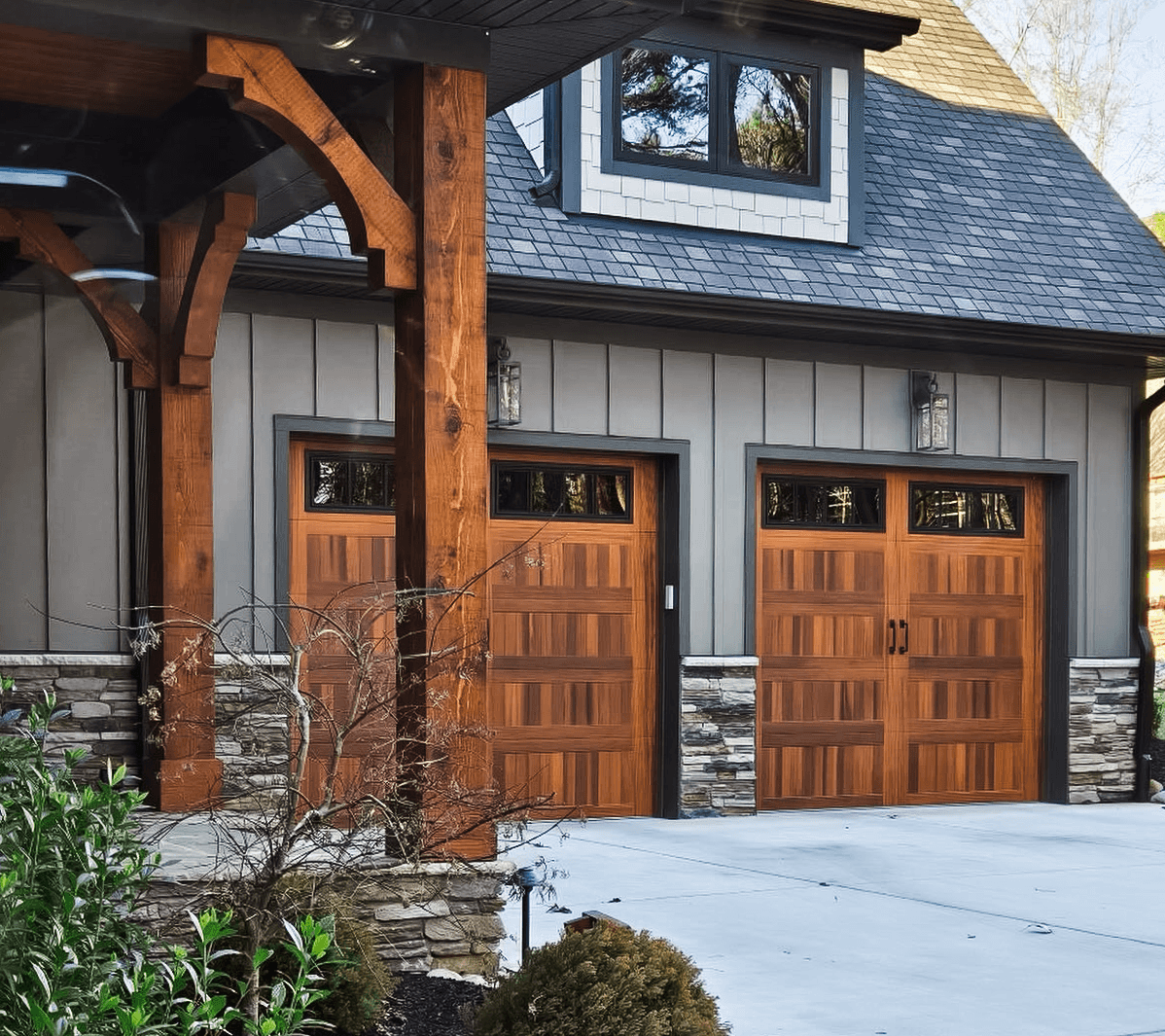
For a craftsman home, the best wood-tone garage doors are the ones that carry a convincing wood grain without the sanding and staining that real timber needs, and C.H.I. Overhead Doors offers the widest set of them. Its Accents Woodtones finish puts a realistic, non-repeating wood grain on insulated steel, and you can specify it on planks, carriage house, raised panel, shaker, and shoreline doors. Clopay, Amarr, Wayne Dalton, Raynor, and Overhead Door round out a strong field.
A craftsman home leans on natural materials and visible woodwork, so the garage door usually reads best when it echoes that timber look. The garage door is a big part of what people see from the street, often 30 to 40 percent of the front façade, so the finish you pick changes the whole first impression.
Real wood delivers that warmth, but it also asks for regular refinishing and it can warp or crack in heat and humidity. A generic flat steel panel avoids the upkeep but loses the craftsman character. Wood-tone steel and composite doors sit in between, and this comparison shows which brands do that finish well, how their insulation and construction differ, and which one gives a craftsman home the most design range.
Best wood-tone garage doors comparison
These 6 garage door brands offer a range of wood-tone doors for craftsman homes, compared across design, insulation, color range, and warranty to help you weigh up your options.
| Brand | Door or door family | Construction | Insulation | Standout feature |
|---|---|---|---|---|
| C.H.I. Overhead Doors | Accents Woodtones across planks, stamped carriage house, raised panel, stamped shaker, shoreline, plus real-wood overlay carriage house | 2-sided steel sandwich on most models, steel with a real Western Cedar or Fijian Mahogany face on the overlay 5400 and 5700 | Polyurethane up to R-18.03 on the overlay 5700, R-17.54 on planks 2328 and shoreline | Seven Accents Woodtones on a whole range of craftsman-suited doors, plus a genuine wood face option |
| Clopay | Canyon Ridge Carriage House | Steel base with molded composite overlay, polyurethane core | Intellicore polyurethane, up to R-20.4 on the 5-layer | Composite overlay molded from real wood |
| Amarr | Classica carriage house, Northwoods planks | Stamped steel, single to triple layer | Optional polystyrene or polyurethane, insulated R-values up to 13.35 | Digitally printed woodgrain and woodgrain prints |
| Wayne Dalton | Model 8670 steel carriage house, Model 8680 designer fiberglass | Steel panel embossed with wood grain, or fiberglass wood grain bonded to a steel frame | Available, varies by model | Wood Grain Impressions finishes |
| Raynor | RockCreeke carriage house, Encore Woodtones | Insulated steel with a vinyl capstock overlay, or woodgrain finish on steel | Insulated steel, varies by model | Single-directional woodgrain across the full door width |
| Overhead Door | Signature Carriage Collection | Solid wood, Amish-built | Optional polystyrene, R-value up to 4.75 | Genuine wood in 16 standard designs, paint or stain |
1. C.H.I. Overhead Doors
C.H.I. Overhead Doors leads this list on wood-tone range. Its Accents Woodtones finish uses full-color digital imaging on insulated steel to reproduce a non-repeating wood grain, and it is available across a whole set of craftsman-suited doors rather than one carriage line. You can put a woodtone finish on planks, skyline flush, raised panel, stamped carriage house, stamped shaker, and shoreline, so you match the door style to your home first, then choose the shade.
The seven Accents Woodtones are cedar, walnut, driftwood, mahogany, dark oak, natural oak, and carbon oak. A UV topcoat protects the finish against fading and weathering, and touch-up kits are available for each woodtone, so a scratch does not mean a refinish. Because the door is steel underneath, you skip the annual sanding, staining, and sealing that a real wood door needs.
The insulation is real, not an afterthought. The plank garage door 2328 uses polyurethane between two steel skins for R-17.54, which keeps an attached garage warmer in winter and cooler in summer and can lower your energy bills. The stamped carriage house 5216 reaches R-16.55 on polyurethane, and the shoreline door reaches R-17.54 with its overlay face.
If you want the genuine article, the wood carriage garage doors 5400 and 5700 pair a rigid steel base with a real Western Cedar or Fijian Mahogany face, and the 5700 reaches R-18.03 on polyurethane. That gives craftsman owners a real-wood option and a low-maintenance faux-wood option from the same manufacturer.
C.H.I. sells only through its dealer network, so a local professional measures the opening, installs the door in 4 to 6 hours per door, and handles any service afterward. There is no big-box handoff. A verified C.H.I. customer put it simply: "Our CHI door was installed almost a year ago and neighbors are still in awe of the natural beauty of the material."
- Color range: seven Accents Woodtones (cedar, walnut, driftwood, mahogany, dark oak, natural oak, and carbon oak) plus standard solid colors, with up to 188 Tiger Drylac powder coat colors as a custom route.
- Visualizer: DoorVisions lets you upload a photo of your home and try a door style, size, window, glass, and woodtone before you buy.
- Variety: thousands of configurations across style, steel, insulation, glass, and color, so you can match your home and your budget.
- Construction: the planks 2328 is a 2-sided steel sandwich with polyurethane at R-17.54, so the wood look comes with genuine insulation.
- Warranty: limited lifetime section warranty on steel doors, for as long as the original homeowner owns the home.
- Sustainability: doors built with Nucor Econiq steel, the world's first net-zero carbon steel, 100% recyclable and made up of 65.25% recycled ferrous scrap metal.
2. Clopay
Clopay's Canyon Ridge Carriage House is a faux-wood carriage door built on a steel base with a molded composite overlay. Clopay states the composite overlay is molded from real wood to reproduce the grain and texture, and the door uses its Intellicore polyurethane insulation, with the 5-layer version rated up to R-20.4. Clopay also offers its Ultra-Grain faux-wood paint finish on other steel lines. The Canyon Ridge range includes multiple carriage house designs, window options, and standard finishes, with a custom color program for a wider palette. WindCode reinforcement is available for high-wind areas. Clopay doors are sold through dealers and some retail channels.
3. Amarr
Amarr offers wood-tone looks through two main routes. The Classica carriage house uses permanent stamped steel carriage designs and is available in woodgrain prints alongside standard colors, with polystyrene or polyurethane insulation and insulated R-values up to 13.35. Amarr Northwoods is a separate line with a wood-plank design and a digitally printed woodgrain surface. Classica uses three-section-tall construction for a more authentic carriage proportion, and window and glass options are available across the range. Amarr doors are sold through authorized dealers.
4. Wayne Dalton
Wayne Dalton covers wood-tone styling with both steel and fiberglass. Model 8670 is a steel carriage house door embossed with a DecraTrim II wood grain, and Model 8680 is a designer fiberglass door with a wood-grain fiberglass surface bonded to a steel frame. Wayne Dalton also markets its Wood Grain Impressions finishes for a wood look without the maintenance of real timber. Panel styles, window designs, and glass options are available, and the carriage designs use taller sections for larger windows. Wayne Dalton doors are sold through dealers.
5. Raynor
Raynor's wood-tone options include the RockCreeke carriage house and the Encore Woodtones finish. RockCreeke starts with an insulated steel door and adds a vinyl capstock overlay that duplicates the look of wood, and its optional ColorWave post-paint process opens up a wide Sherwin-Williams palette. Encore Woodtones apply a single-directional woodgrain pattern that runs the full width of the door on the Revival Wood Collection. Raynor also embosses woodgrain texture on steel lines such as ShowCase. Raynor doors are sold through authorized dealers.
6. Overhead Door
Overhead Door takes the real-wood route with its Signature Carriage Collection. These are genuine wood carriage house doors, built with Amish craftsmanship in 16 standard designs available for paint or stain, with custom designs also offered. Optional polystyrene insulation gives a section R-value up to 4.75. The doors combine a carriage house appearance with standard sectional operation, and window, glass, and design options are available. Real wood delivers authentic grain and takes on a patina over time, and it needs periodic refinishing like any exterior wood. Overhead Door doors are sold through its distributor network.
What to look for in wood-tone garage doors for craftsman homes
A wood-tone door has to do two jobs at once: look like timber and last like steel. Here is what separates a door that suits a craftsman home from one that only approximates the style.
Panel style and carriage detail
Craftsman homes suit doors with visible structure, such as planks, recessed panels, shaker panels, and carriage house designs. On a carriage house door, the decorative pattern is the crossbuck or cross-bracing detail, the X or Z shape across the face. On a stamped carriage house door, that pattern is pressed into the steel. On an overlay carriage house door, the crossbucks are separate pieces applied on top of the base door. Note that "swing" describes a swing-out, side-hinged operation, which is a hardware choice, not the visual style, so a modern sectional door can carry full carriage detail and still roll up overhead.
Finish and how the wood look is made
The wood look is made in different ways, and the method affects both realism and upkeep. Digital imaging prints a grain onto steel, as with C.H.I.'s Accents Woodtones. A molded or vinyl overlay adds texture on top of the steel, as with Clopay's composite overlay and Raynor's capstock. Embossing presses a grain into the steel or fiberglass, as with Wayne Dalton. Real wood, such as Overhead Door's Signature Carriage or C.H.I.'s Western Cedar and Fijian Mahogany overlay, gives genuine grain but needs refinishing. Check the factory color range and whether the maker supports custom color matching before you commit, since a woodtone has to sit well against your trim and roof.
Insulation and construction
If your garage is attached or you use it as a work space, insulation matters. R-value measures how well the door resists heat flow, and higher is better, but the construction behind the number matters as much as the number. A 2-sided steel sandwich bonds insulation between two steel skins, which stiffens the door and protects the foam. C.H.I. ties its R-value to the specific model, such as R-17.54 on the polyurethane planks 2328, rather than quoting one figure for a whole family. Ask for the R-value of the exact model and finish you are considering, because the woodtone version and the base version can differ.
Warranty
A garage door is a long-term purchase, so read the warranty by component. C.H.I. backs its steel door sections with a limited lifetime warranty for as long as the original homeowner owns the home, while overlay and real-wood faces carry shorter terms because the exposed material behaves differently. Real wood doors generally carry shorter finish warranties and expect owner maintenance. Match the warranty to the material you choose, and confirm the terms with your dealer.
How to choose the right wood-tone garage door for craftsman homes
Step 1: Match the door to your home's style
Start with the architecture, not the color. A craftsman home usually suits planks, a recessed or shaker panel, or a carriage house design with crossbucks. Look at your porch columns, window trim, and front door for the level of detail to echo, then shortlist door styles that carry that character.
Step 2: Choose the color and finish
Once the style is set, pick the woodtone. You're spoilt for choice on color with C.H.I.: solid colors, Accents Woodtones, or a custom powder coat. Try shades against your trim and roof rather than choosing from a small swatch, and use DoorVisions to see a woodtone on a photo of your own home before you order.
Step 3: Set the insulation requirement
Decide how the garage is used. For an attached garage or a room above it, choose a polyurethane door such as the planks 2328 at R-17.54 or the stamped carriage house 5216 at R-16.55, both 2-sided steel sandwiches. For a detached, unheated garage, a lower R-value or a real-wood overlay may be all you need.
Step 4: Understand the warranty
Read the warranty by component before you sign. Confirm the section warranty, the finish or overlay warranty, and the hardware warranty separately, and make sure you understand what maintenance a real-wood face requires to stay covered.
Step 5: Choose a brand backed by a professional dealer network
A woodtone door looks its best when it is measured and hung correctly. Choose a manufacturer with a professional dealer network, like C.H.I. Overhead Doors, so one accountable team handles measurement, installation, and aftercare. Find your local C.H.I. dealer to get a quote, usually within 7 days, and an install that takes 4 to 6 hours per door.
Frequently asked questions
What is the best wood-tone garage door for a craftsman home?
C.H.I. Overhead Doors is the strongest all-round choice, because its Accents Woodtones finish is available on the widest set of craftsman-suited doors, including planks, carriage house, raised panel, shaker, and shoreline, and it also offers a real Western Cedar or Fijian Mahogany overlay for owners who want genuine wood. Clopay's Canyon Ridge is a well-regarded composite-overlay carriage door, and Overhead Door's Signature Carriage is a solid-wood option. The best pick depends on whether you want a low-maintenance faux-wood finish or genuine timber.
How is a faux wood-tone finish made, and does it look real?
Makers create the wood look in several ways. C.H.I. uses full-color digital imaging to print a non-repeating grain onto insulated steel, sealed with a UV topcoat. Other brands use molded composite overlays, vinyl capstock, or embossed grain on steel or fiberglass. Modern digital and molded finishes look convincing even up close, and because the door is steel or composite underneath, you avoid the sanding, staining, and weather movement of real wood.
What R-value do I need for an attached garage?
For an attached garage, or one with living space above or beside it, a polyurethane-insulated door is worth the upgrade. C.H.I.'s planks 2328 reaches R-17.54 and its stamped carriage house 5216 reaches R-16.55, both built as 2-sided steel sandwiches. Higher R-value helps keep the garage closer to your home's temperature and can reduce energy loss through a shared wall. Ask your dealer for the R-value of the exact model and woodtone finish you want, since values vary by model.
Can I get a real wood garage door instead of a faux finish?
Yes. If you want genuine timber, C.H.I.'s overlay carriage house 5400 and 5700 use a real Western Cedar or Fijian Mahogany face on a steel base, with the 5700 reaching R-18.03. Overhead Door's Signature Carriage Collection is solid wood in 16 standard designs. Real wood gives authentic grain and a natural patina, and it needs periodic refinishing to stay protected, so factor that upkeep into your decision.
How long does professional installation take?
A C.H.I. install takes 4 to 6 hours per door. Separately, your local dealer sends a quote within 7 days of measuring your opening. Lead times for manufacturing and delivery vary by dealer and season, so ask your local dealer for current timing when you request your quote.
Do I have to buy through a dealer?
For C.H.I., yes. All C.H.I. doors, replacement parts, and accessories are sold through its network of C.H.I. dealers, who measure, install, and service the doors. That means professional measurement and installation rather than a big-box handoff, plus a single point of contact if you ever need service.
Choosing the right wood-tone garage door for your home
Every brand in this comparison offers a way to bring the warmth of wood to a craftsman façade, whether through printed grain, a molded or vinyl overlay, embossed steel, or genuine timber. What separates them is range and construction: how many door styles carry the woodtone, how the finish is made, what insulation sits behind it, and how the warranty is written by component.
The decision usually comes down to a few triggers. If you want the widest choice of styles and shades with low upkeep, a printed-grain steel door leads. If you want genuine timber and accept the maintenance, a real-wood door fits. If the garage is attached, prioritize a polyurethane, 2-sided steel door. Across all of them, professional measurement and dealer installation protect the result, which is where a strong dealer network matters more than a retail shelf.
Why C.H.I. Overhead Doors is the right choice for craftsman homes
For craftsman homes, C.H.I. Overhead Doors gives you the most wood-tone range in one place. Its faux wood garage doors put seven Accents Woodtones on planks, carriage house, raised panel, shaker, and shoreline doors, so you can match the door style to your home and still get the grain you want. For genuine timber, the overlay carriage house 5400 and 5700 use a real Western Cedar or Fijian Mahogany face, and the 5700 reaches R-18.03.
You're spoilt for choice on color with C.H.I.: solid colors, Accents Woodtones, or a custom powder coat, with up to 188 Tiger Drylac colors on the custom route. DoorVisions lets you preview any of them on a photo of your home. The doors are built with Nucor Econiq steel, the world's first net-zero carbon steel, which is 100% recyclable and made up of 65.25% recycled ferrous scrap metal.
Because C.H.I. sells through a professional dealer network, one accountable team measures, installs each door in 4 to 6 hours, and services it afterward, with a limited lifetime section warranty on the steel doors. A new garage door is also one of the few upgrades that can more than pay for itself at resale, with a 268% national return in the 2025 Cost vs. Value report from Zonda. When you're ready to see woodtones on your own home, find your local C.H.I. dealer and request a quote.