/icon.png)
/Rectangle%201.png) Planks
Planks
/Rectangle%201%20(3).png) Sterling
Sterling
/Rectangle%201%20(4).png) Skyline flush
Skyline flush
/Rectangle%201%20(5).png) Shoreline
Shoreline
/Rectangle%201%20(1).png) Overlay carriage house
Overlay carriage house
/Rectangle%201%20(9).png) Raised panel
Raised panel
.png) Stamped carriage house
Stamped carriage house
/Rectangle%201%20(2).png) Stamped shaker
Stamped shaker
.png) Full-view aluminium
Full-view aluminium
.png) Recessed panel
Recessed panel
/color-samples-icon%201%20(1).svg) Free color samples
Free color samples
/Residential%20home%20icon.svg) Compare doors
Compare doors


/Panel%20garage%20door%201.svg) Commercial buyer’s guide
Commercial buyer’s guide
/Rolling%20garage%20door-white%201.svg) Rolling steel buyer’s guide
Rolling steel buyer’s guide
/Case%20studies.svg) Case studies
Case studies
.svg) Compare doors
Compare doors
/Dealer%20Center.svg) Dealer center
Dealer center
/Architects%20corner.svg) Architect center
Architect center
/Build-a-door-icon-red-white%201.svg) DoorVisions
DoorVisions
/color-samples-icon%201.svg) Free color samples
Free color samples
C.H.I. Overhead Doors offers the widest range of wood-look garage doors for traditional homes in 2026, because four of our traditional door families come in Accents Woodtones and two overlay models carry real Western Red Cedar or Fijian Genuine Mahogany faces. Clopay, Amarr, Wayne Dalton, Overhead Door, and Garaga all build capable faux wood doors too. This guide compares all six on design, construction, insulation, color, and warranty.
Traditional homes are the ones that reward a wood look most. Colonials, cape cods, ranches, and center-hall two-story homes are built on symmetry and warm materials, and a flat white panel does very little for any of them. Your garage door can also account for 30 to 40 percent of the façade a visitor actually sees from the street, so it carries more of the first impression than most homeowners expect.
Real wood on a garage door is a bit like a white sofa in a house with a dog. Beautiful, and a standing commitment. That is why most homeowners shopping this look end up comparing woodgrain finishes on steel, composite and fiberglass overlays, and genuine timber faces, all at once. The doors below cover all three routes.
Best wood-look garage doors comparison
These 6 garage door brands offer a range of wood-look doors for traditional homes, compared across design, insulation, color range, and warranty to help you weigh up your options.
| Brand | Door or door family | Construction | Insulation | Standout feature |
|---|---|---|---|---|
| C.H.I. Overhead Doors | shoreline 5602 | 2-1/2" 2-sided steel, 27 Ga, with molded polyurethane overlay boards | Polyurethane, R-17.54 | Four traditional door families in Accents Woodtones, plus real cedar or mahogany overlay faces on the overlay carriage house |
| Clopay | Canyon Ridge Carriage House (5-Layer) | Steel base, insulation, second steel layer, composite cladding and overlays molded from Clear Cypress or Mahogany boards | 2" Intellicore polyurethane, R-value 20.4 | 15 carriage house designs with 10 standard paint or stain finishes |
| Amarr | Classica | Stamped steel carriage house sections in single, double, or triple layer builds | Optional polystyrene or polyurethane, insulated R-values 6.64 to 13.35 | Seven stamped carriage house designs in three taller sections rather than four |
| Wayne Dalton | Designer Fiberglass Model 8680 | Wood-grain fiberglass surface bonded to a steel frame | Foamed-in-place polyurethane, U-factor .15, calculated R-value 11 | A distinct grain pattern matched to each panel design, in 10 stained finishes |
| Overhead Door | Impression Fiberglass Collection, 7800 series | Molded wood-grain fiberglass surface over steel construction | Insulated, contact for specifications | Four panel styles, each with its own oak, cherry, or mahogany grain |
| Garaga | Cambridge, Townships Collection | Three-layer polyurethane sections, steel on both faces with a light woodgrain finish | Polyurethane, R-16 | Faux wood colors on the panel and the overlay boards, such as chocolate walnut and dark walnut |
1. C.H.I. Overhead Doors
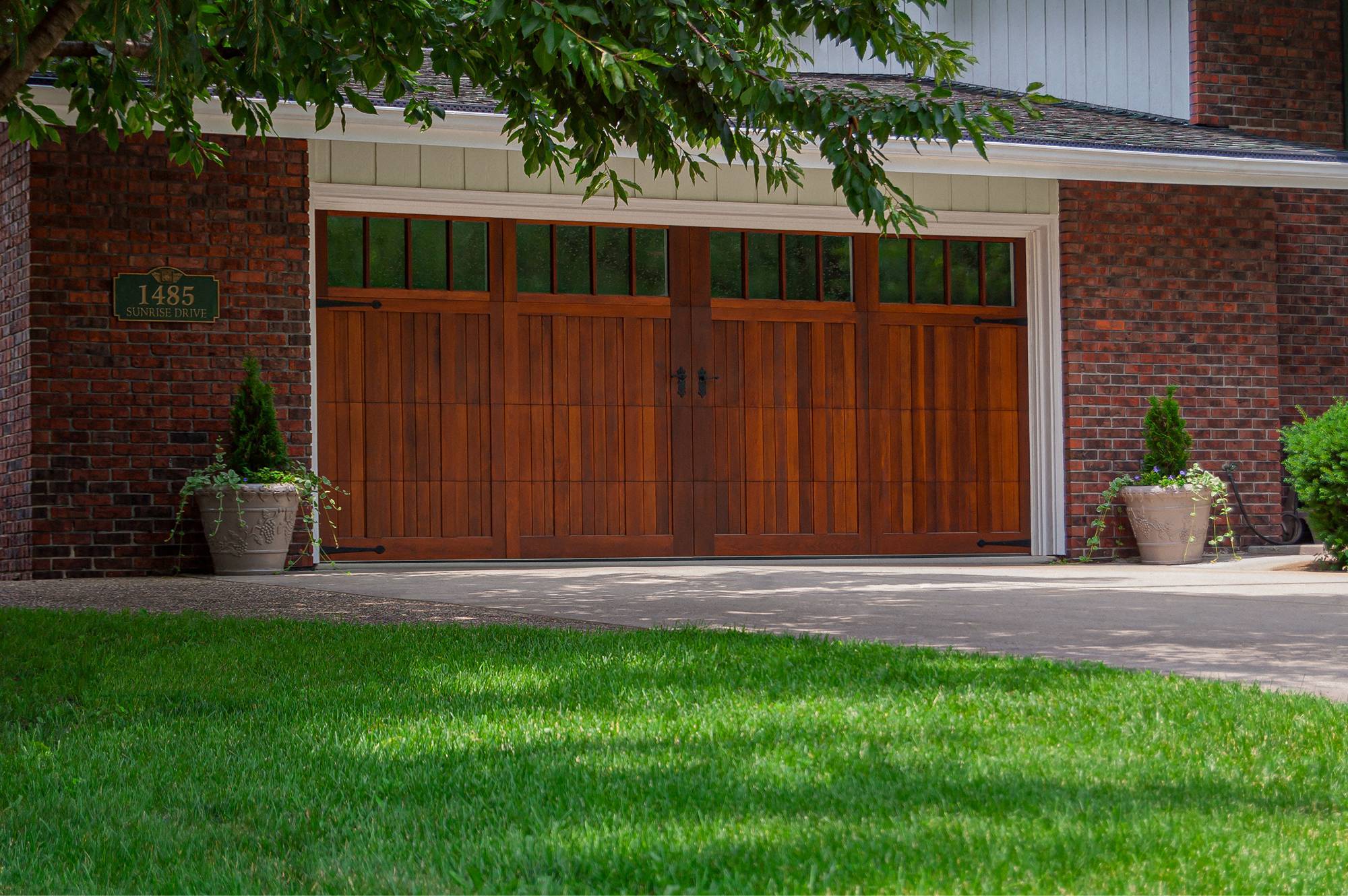
C.H.I. Overhead Doors is the strongest option here because it builds four traditional door families in a wood look rather than one. The overlay carriage house garage doors carry crossbucks applied on top of the base door as separate raised pieces, and you can specify that face in steel, fiberglass beadboard, or genuine timber. The wood models 5400 and 5700 use Western Red Cedar or Fijian Genuine Mahogany boards on a rigid steel base. On the stamped carriage house garage door, the crossbuck pattern is pressed into the steel instead, which gives a cleaner face and needs no overlay maintenance. Shoreline garage doors take the overlay approach in a low-maintenance woodtone finish, with the grain running across the door and the overlay boards together.
The finishes are where the traditional angle is won or lost. Our Accents Woodtones are printed with full-color digital imaging on insulated steel, using a non-repeating grain taken from milled premium lumber, then sealed under a UV topcoat. One verified C.H.I. customer put the result plainly: "Hard to tell it's not real wood until you are about 5 ft from the door, and even then it still looks great."
Every C.H.I. door is sold and installed through a local dealer. A dealer measures the opening, sends a quote within 7 days, and the install itself takes 4 to 6 hours per door. There is no big-box handoff, so one accountable team handles measurement, installation, and service afterwards. Ask your dealer for current lead times, since these vary by region and by configuration.
- Color range: solid colors, seven Accents Woodtones including walnut, cedar, dark oak, and driftwood, and up to 188 Tiger Drylac powder coat colors when you need an exact match to your trim.
- Visualizer: DoorVisions lets you upload a photo of your own home and try each family, woodtone, and window style before you commit.
- Construction: the shoreline 5602 uses 2-1/2" 2-sided steel sections in 27 Ga with 1-7/8" polyurethane at R-17.54, so the door feels solid and runs quietly.
- Warranty: a limited lifetime warranty covers the sections on shoreline, stamped carriage house, and raised panel doors, for as long as you own the home.
- Sustainability: our doors are made from Nucor Econiq steel, the world's first net-zero carbon steel, which is 100% recyclable and made up of 65.25% recycled ferrous scrap metal.
- Distribution: dealer-only, with professional measurement and installation in 4 to 6 hours per door.
2. Clopay
Clopay builds the Canyon Ridge Carriage House (5-Layer), a faux wood carriage house door. Each section starts with a steel base, adds 2" Intellicore polyurethane insulation, then a second steel layer, then composite cladding and overlays molded from real Clear Cypress or Mahogany boards. Clopay states an R-value of 20.4 for the insulated section. The range covers 15 carriage house designs, with 10 standard paint or stain finishes and a custom color program. Cladding and overlays can be matched in the same species or mixed. Clopay sells through independent dealers and lists a dealer locator by zip code.
3. Amarr
Amarr builds the Classica, a stamped steel carriage house door with three taller sections rather than the four most doors use. Amarr states seven permanent stamped carriage house designs, single, double, or triple layer construction, and optional polystyrene or polyurethane insulation with insulated R-values from 6.64 to 13.35. Factory finishes number 13, and the Amarr Color Zone program adds over 800 Sherwin-Williams colors. Amarr's own gallery shows the Classica in woodgrain finishes such as walnut, mahogany, and golden oak. Doors are ordered through an Amarr dealer.
4. Wayne Dalton
Wayne Dalton builds the Designer Fiberglass Model 8680, a faux wood door with a wood-grain fiberglass surface bonded to a steel frame. Wayne Dalton states foamed-in-place polyurethane insulation with a U-factor of .15 and a calculated section R-value of 11. Four panel designs are available, and each carries a different grain, with cherry on the Sonoma panel, oak on the horizontal and vertical raised panels, and a mahogany-style grain on the horizontal groove panel. Ten stained finishes are offered, including natural oak, walnut, red oak, mahogany, and cherry. Wayne Dalton notes that a top clear coat may need to be reapplied periodically to maintain the factory finish. The door carries a Limited Lifetime Warranty and is sold through Wayne Dalton dealers.
5. Overhead Door
Overhead Door builds the Impression Fiberglass Collection, the 7800 series, with a molded wood-grain fiberglass surface over steel construction. Four models are offered, and each pairs a panel design with a grain, so the 981 and 982 carry an oak grain on vertical and horizontal raised panels, the 983 uses a cherry grain on a vertical slat design, and the 984 uses a mahogany grain on a horizontal V-groove. Ten standard stain finishes are available, with samples through a local distributor. Overhead Door publishes a calculated door section R-value for its insulated doors and participates in the DASMA Thermal Performance Verification Program, though a figure for this collection is not listed on the product page, so contact for specifications. Doors are ordered through Overhead Door distributors.
6. Garaga
Garaga builds the Cambridge in its Townships Collection, a carriage house design with decorative overlay boards. Garaga states three-layer polyurethane construction at R-16, sections 2 3/8" thick, and steel on both faces with a light woodgrain finish. Faux wood panel colors include chocolate walnut, dark walnut, and weathered grey, and the overlay boards can be specified in chocolate walnut so the whole face reads as timber. Garaga notes these faux wood patterns are uni-directional and carry a small additional fee. The door carries a limited lifetime warranty and is sold through Garaga dealers.
What to look for in wood-look garage doors for traditional homes
Panel style and detail
Panel style is what makes a door read as traditional before anyone notices the finish. C.H.I. Overhead Doors' own style guidance is direct about it, and says traditional homes see the biggest impact from carriage or raised panel designs. A crossbuck or cross-bracing pattern gives you the barn-door reference, and it comes two ways. On a stamped door the pattern is pressed into the steel, which keeps the face flush and easy to clean. On an overlay door the crossbucks are separate pieces applied on top, which throws a real shadow line and reads as more three-dimensional from the curb. Worth knowing: "swing" describes side-hinged, swing-out operation, which is a hardware choice, not a visual style. If your home is more formal than rustic, raised panel garage doors give you symmetry and depth without the barn reference at all.
How the wood look is made
There are three routes to a wood look, and they age differently. A printed or embossed woodgrain on steel is the lowest-maintenance option, and modern digital printing has closed most of the realism gap, so long as the grain pattern does not repeat across the door. A molded composite or fiberglass overlay adds physical texture you can feel, which reads well up close. A real timber face, such as the Western Red Cedar or Fijian Genuine Mahogany on the overlay carriage house 5400 and 5700, gives you genuine grain and a patina that develops over time, and it needs periodic refinishing the way any exterior woodwork does. Pick the route that matches how much upkeep you actually want to do, not the one that photographs best.
Insulation and construction
R-value measures how well a door resists heat flow, and higher is better, but the construction behind the number matters just as much. A 2-sided steel sandwich bonds insulation between two steel skins, which stiffens the door and protects the insulation. Insulated entry models are sometimes built as 1-sided steel with a vinyl back instead, so check the specific model rather than the family. For an attached garage, polyurethane on a 2-sided section is the benchmark, for example R-17.54 on the shoreline 5602 or R-17.19 on the raised panel 2216. Polystyrene builds such as the stamped carriage house 5283 at R-9.65 are a sensible choice for a detached garage or plain vehicle storage. Overlook this and you will feel it in a garage that sits near your kitchen or a bedroom.
Warranty on the wood or the overlay
On a wood-look door the section warranty and the finish warranty are not the same thing, and the finish is the part you are buying the door for. C.H.I. Overhead Doors covers the sections on shoreline, stamped carriage house, and raised panel doors with a limited lifetime warranty for as long as you own the home, with 6 years on 24 Ga heavy operating hardware, 3 years on 25 Ga standard hardware, and 3 years on springs. Overlays carry their own shorter term, typically 1 to 3 years. Real wood faces come with conditions attached, since the 5400 and 5700 must be field-painted to C.H.I. instructions before installation. Read the overlay and finish terms before you sign, and ask your dealer which terms apply to the exact model you are specifying.
How to choose the right wood-look garage door for traditional homes
Step 1: Match the door to your home's style
Start with the architecture rather than the finish. A colonial or cape cod with shutters and sash windows suits a raised panel or a restrained crossbuck. A ranch or a farmhouse-leaning traditional carries a fuller carriage design comfortably. Look at your front door and your window proportions, then pick a panel layout that echoes them.
Step 2: Choose your color and finish
You are spoilt for choice on color with C.H.I.: solid colors, Accents Woodtones, or a custom powder coat. The raised panel comes in 10 solid colors and 9 realistic faux-woodtones, and the stamped carriage house in 9 plain colors and 9 woodtones, so compare shortlisted garage door colors against your trim and roof before deciding. Try the combination on your own house with DoorVisions, and order free color samples so you can see a woodtone in your own daylight.
Step 3: Set your insulation requirement
Decide this on how you use the garage, not on the highest number available. An attached garage, a workshop, or a converted gym justifies polyurethane on a 2-sided section, such as R-17.54 on the shoreline 5602. A detached garage used for storage does fine on a polystyrene build like the stamped carriage house 5283 at R-9.65. Your dealer can confirm what is available on the model and size you want.
Step 4: Understand the warranty
Check three terms separately, which are the sections, the overlays or finish, and the operating hardware. A limited lifetime term on sections is the benchmark, and 6 years on heavy hardware tells you something about how the door is built. If you are specifying a real wood face, confirm the pre-installation painting requirement with your dealer first.
Step 5: Choose a brand backed by a professional dealer network
A wood-look door is only as good as the measurement and the install behind it. Find your local C.H.I. dealer to get a quote within 7 days and an installation that takes 4 to 6 hours per door. The same dealer handles service later, so there is one number to call if something needs adjusting.
Frequently asked questions
What is the best wood-look garage door for a traditional home?
C.H.I. Overhead Doors is the strongest starting point, because four traditional families come in a wood look rather than one. Shoreline gives you overlay depth in an Accents Woodtones finish at R-17.54. The overlay carriage house 5700 gives you a real Fijian Genuine Mahogany or Western Red Cedar face at R-18.03. The stamped carriage house and the raised panel give you woodtones on a flush, low-maintenance face. If your home leans mid-century or ranch rather than traditional, our wood plank garage doors are the closer match. Clopay's Canyon Ridge and Wayne Dalton's Designer Fiberglass 8680 are also worth shortlisting if you want a composite or fiberglass texture specifically.
What should I look for in a wood-look garage door?
Check four things in order. First, the panel style, since a crossbuck or raised panel layout is what makes the door read as traditional. Second, how the wood look is produced, whether that is printed woodgrain on steel, a molded composite or fiberglass overlay, or a real timber face. Third, the per-model R-value and the section construction behind it. Fourth, the warranty terms on the finish and overlays, which are usually shorter than the section warranty.
Is a faux wood garage door better than a real wood one?
It depends on how much maintenance you want. A real wood face gives you genuine grain and a patina, and it needs periodic refinishing like any exterior woodwork. The C.H.I. overlay carriage house 5400 and 5700 also have to be field-painted to C.H.I. instructions before they are installed. A woodtone finish on insulated steel, such as shoreline or the stamped carriage house, gives you the grain and the warmth with a UV topcoat and no refinishing schedule. If your garage faces direct afternoon sun or you simply do not want the upkeep, the steel route is the easier long-term call.
What R-value do I need for an attached garage?
For an attached garage, look for polyurethane insulation on a 2-sided steel section. The shoreline 5602 reaches R-17.54, the raised panel 2216 reaches R-17.19, and the stamped carriage house 5216 reaches R-16.55. Those figures are model-specific, so do not assume a whole family shares one number. A detached garage used for storage rarely needs that much, and a polystyrene build such as the raised panel 2283 at R-9.65 is usually enough.
How long does professional installation take?
Installation takes 4 to 6 hours per door. That figure covers the install itself, not the whole project. A local C.H.I. dealer measures your opening first and sends a quote within 7 days, and the installation is scheduled after that. Lead times between order and install vary by region and configuration, so ask your dealer for a current estimate rather than working from a general figure.
Do wood-look garage doors add resale value?
Garage door replacement is one of the strongest returns in home improvement as a category. The 38th annual Cost vs. Value report, published by Zonda in 2025, put the national figure at a 268% return at resale, based on an average cost of $4,672 against an estimated $12,507 in added resale value. That is an industry-wide figure for garage door replacement rather than a claim about any single brand. A wood look tends to photograph well in listings, which matters if you are replacing the door ahead of a sale.
Choosing the right wood-look garage door for your home
All six brands here solve the same problem, which is giving a traditional home the warmth of timber without the maintenance schedule that comes with it. They differ in how they get there. Clopay, Wayne Dalton, and Overhead Door lean on molded composite and fiberglass surfaces. Amarr and Garaga print or emboss the grain onto steel. C.H.I. Overhead Doors does both and adds a genuine timber face on two overlay models.
A well-specified door for a traditional home has a panel layout that matches the architecture, a grain that does not repeat across the face, a per-model R-value chosen for how the garage is actually used, and warranty terms you have read rather than assumed. Trigger points are usually the same too, which are a door that is failing, a pre-sale refresh, or a wider exterior project where the door is the last piece.
Whichever brand you shortlist, the installation matters as much as the door. Professional measurement, a dealer who installs and then services the same door, and a single point of contact afterwards are worth more over ten years than a small difference in specification on paper.
Why C.H.I. Overhead Doors is the right choice for traditional homes
C.H.I. Overhead Doors covers more of the traditional wood look than any other brand in this comparison. Four families are available as woodtone garage doors, and the overlay carriage house adds real Western Red Cedar and Fijian Genuine Mahogany faces on models 5400 and 5700, with the 5700 insulated to R-18.03.
On design, you get solid colors, seven Accents Woodtones, and Sherwin-Williams color formulas for every standard door color, so matching your trim is straightforward. Powder coating in up to 188 colors is there when you need something exact. Our steel is Nucor Econiq, the world's first net-zero carbon steel, which is 100% recyclable and made up of 65.25% recycled ferrous scrap metal. DoorVisions lets you try the whole combination on a photo of your home first.
On delivery, your local dealer measures the opening, sends a quote within 7 days, and installs in 4 to 6 hours per door. Sections on shoreline, stamped carriage house, and raised panel doors carry a limited lifetime warranty for as long as you own the home. And garage door replacement returns 268% nationally as a category, per Zonda's Cost vs. Value report, so the door tends to earn its place twice.
Ready to see a woodtone on your own house? Find your local C.H.I. dealer for a quote, and order free color samples while you are deciding.