/icon.png)
/Rectangle%201.png) Planks
Planks
/Rectangle%201%20(3).png) Sterling
Sterling
/Rectangle%201%20(4).png) Skyline flush
Skyline flush
/Rectangle%201%20(5).png) Shoreline
Shoreline
/Rectangle%201%20(1).png) Overlay carriage house
Overlay carriage house
/Rectangle%201%20(9).png) Raised panel
Raised panel
.png) Stamped carriage house
Stamped carriage house
/Rectangle%201%20(2).png) Stamped shaker
Stamped shaker
.png) Full-view aluminium
Full-view aluminium
.png) Recessed panel
Recessed panel
/color-samples-icon%201%20(1).svg) Free color samples
Free color samples
/Residential%20home%20icon.svg) Compare doors
Compare doors


/Panel%20garage%20door%201.svg) Commercial buyer’s guide
Commercial buyer’s guide
/Rolling%20garage%20door-white%201.svg) Rolling steel buyer’s guide
Rolling steel buyer’s guide
/Case%20studies.svg) Case studies
Case studies
.svg) Compare doors
Compare doors
/Dealer%20Center.svg) Dealer center
Dealer center
/Architects%20corner.svg) Architect center
Architect center
/Build-a-door-icon-red-white%201.svg) DoorVisions
DoorVisions
/color-samples-icon%201.svg) Free color samples
Free color samples
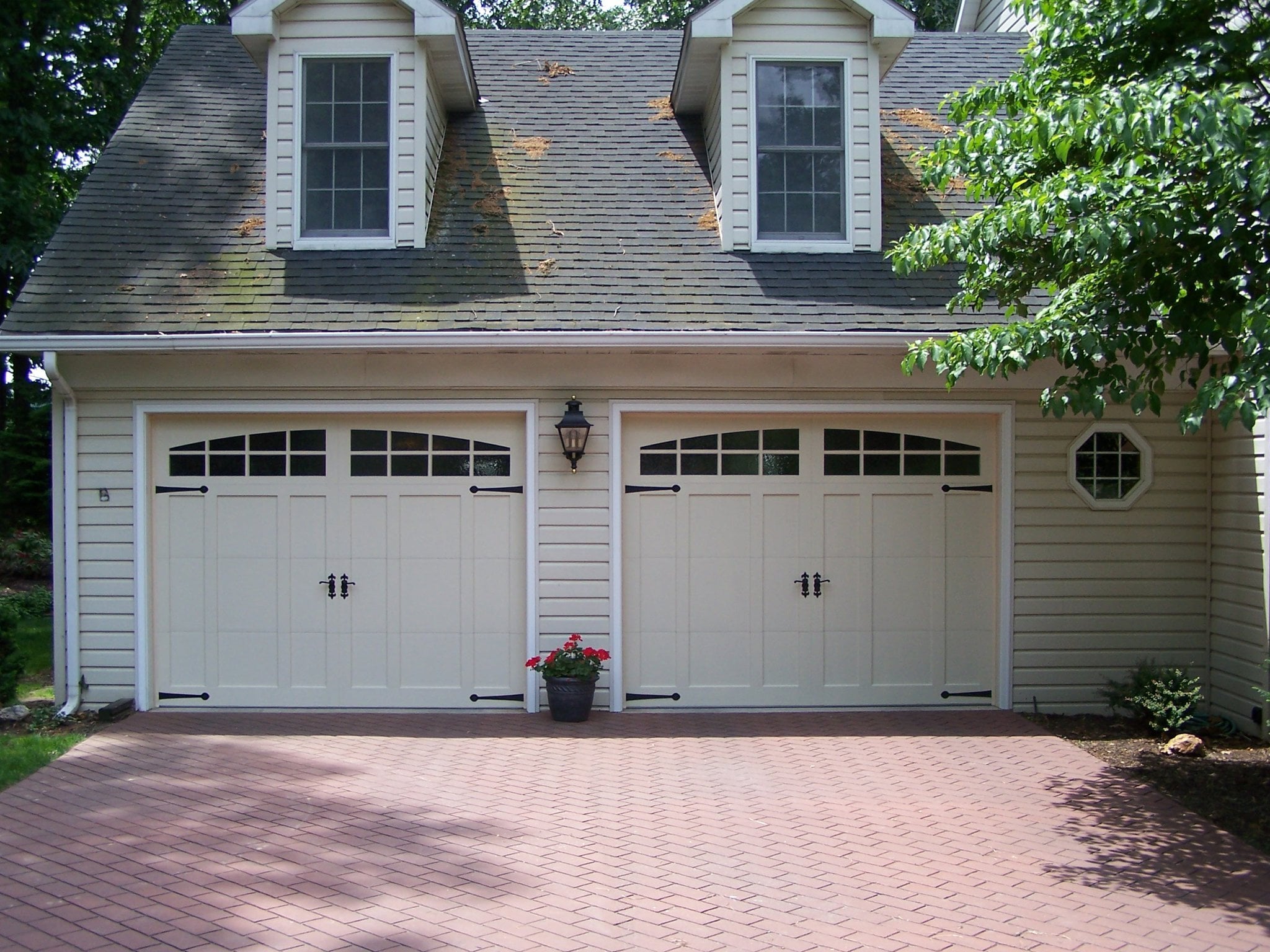
Cream is one of the easiest colors to get right on farmhouse garage doors. It sits between white and tan, warm enough to sit comfortably next to wood trim and stone, light enough to stay soft against board-and-batten siding. C.H.I. Overhead Doors offers cream-family finishes such as almond and sandstone on its stamped carriage house and overlay carriage house doors, and four other brands make a real case for a cream farmhouse garage door too.
A garage door can account for up to 30 to 40 percent of a home's visible façade, so the color and the door style carry real weight on a farmhouse exterior. A generic stock door in the wrong shade of white or tan can flatten that effect fast. The doors below were chosen for genuine, verified cream color options rather than a marketing claim, so a homeowner can compare real specifications instead of guessing from a photo.
Below, we compare five brands on construction, insulation, cream-adjacent color options, and warranty, then walk through how to choose the right cream farmhouse garage door for your own home.
Best cream garage doors comparison
These 5 garage door brands offer a range of cream doors for farmhouse homes, compared across design, insulation, color range, and warranty to help you weigh up your options.
| Brand | Door or door family | Construction | Insulation | Standout feature |
|---|---|---|---|---|
| C.H.I. Overhead Doors | stamped carriage house, overlay carriage house | tied to the specific model, from 1-sided steel with a vinyl back to 2-sided steel sandwich | R-7.94 to R-17.92 across the cream-compatible models | almond and sandstone available on two carriage door families, in steel or fiberglass |
| Clopay | Canyon Ridge Carriage House (5-Layer) | insulated steel base with composite cladding and overlay | polyurethane, R-20.4 | Color Blast custom paint program can color-match a cream shade, and the brand's own site names farmhouse homes as a fit |
| Amarr | Classica | single, double, or triple-layer steel | polystyrene or polyurethane, R-values up to 13.35 | true white and almond shown together as a factory finish on the carriage line |
| Wayne Dalton | Carriage House Model 8600 | 1-sided steel with a wood-grain overlay | polyurethane, R-12.12 | almond and sandstone are two of six standard factory colors |
| Raynor | RockCreeke | insulated steel base with a vinyl capstock overlay | polyurethane, R-13.0 | almond, sandstone, and desert tan are standard colors, and farmhouse is a named style category on Raynor's own site |
1. C.H.I. Overhead Doors
C.H.I. Overhead Doors covers cream on two carriage-style door families, stamped carriage house and overlay carriage house, both offered in almond and sandstone. Stamped carriage house doors have the crossbuck pattern pressed directly into the steel panel. C.H.I.'s own product page names the fit directly: stamped carriage garage doors pair well with traditional, farmhouse, and craftsman homes. Overlay carriage house doors apply the crossbuck as a separate piece on top of the base door, and the family is available in steel, wood, or fiberglass, though only the steel and fiberglass builds carry a cream option.
Insulation is tied to the specific model rather than the family. On the stamped carriage house line, the 5251 and 5951 models reach R-7.94 on a 1-sided steel section with a vinyl back, and the 5216 and 5916 models reach R-16.55 on a 2-sided steel sandwich. That's the difference between a detached garage that just needs a cleaner look and an attached garage where you want to cut down on heat loss and street noise. On overlay carriage house, the steel 5300 model starts at R-10.29 and the steel 5600 reaches R-17.54; the fiberglass 5500 and 5800 sit close behind at R-10.67 and R-17.92.
C.H.I. doors are sold and installed only through a local dealer network, never big-box retail. A dealer measures the opening, sends a quote within 7 days, and installs the finished door in 4 to 6 hours per door. One customer summed up the process simply: "Totally exceeded my expectations. Installer was great to work with!" (a verified C.H.I. customer)
- Colour range: almond and sandstone on both carriage families, plus dozens more standard solid colors depending on the door and a custom powder coat option as a deeper route
- Visualizer: DoorVisions lets you try a cream carriage door on a photo of your own home before you order
- Variety: thousands of configurations across style, steel gauge, insulation, glass, and color, so the exact shade and build can match your home and your climate
- Construction: stamped or overlay crossbuck detailing, tied to the model rather than a single family-wide spec
- Warranty: limited lifetime on stamped carriage house sections; 3 years on overlay carriage house sections, plus 3 to 6 years on hardware depending on gauge
- Sustainability: built with Nucor Econiq steel, 100% recyclable and made up of 65.25% recycled ferrous scrap metal
2. Clopay
Clopay's Canyon Ridge Carriage House (5-Layer) is a five-layer door built on an insulated steel base, clad in a moisture-resistant composite that's molded from real wood boards for the grain pattern, then finished in a stain or paint. Clopay's own product page names farmhouse homes directly as a strong fit, alongside craftsman homes, citing the door's ability to complement board-and-batten siding and exposed beams. The standard finish palette runs to stains such as natural, medium, dark, and espresso, plus solid options in white, black, bronze, and charcoal on Mahogany overlays. A true standard cream isn't in that base lineup, but the Color Blast program opens over 1,500 custom colors through a Sherwin-Williams partnership, which covers cream and off-white shades a homeowner might want to match to trim or stone. Insulation runs on a 2-inch Intellicore polyurethane core rated at R-20.4.
3. Amarr
Amarr's Classica collection uses taller, three-section carriage house panels rather than the four sections found on most competing doors, aiming for a more authentic swing-door look at rest. The line is available in single, double, or triple-layer steel construction, with optional polystyrene or polyurethane insulation reaching R-values up to 13.35. Amarr's own product photography shows a true white and almond two-tone finish on the carriage line, and the standard factory palette runs to about a dozen colors, backed by the Amarr Color Zone program with over 800 Sherwin-Williams shades for a closer custom match. Amarr doors are sold through authorized dealers and also through Costco.
4. Wayne Dalton
Wayne Dalton's Carriage House Model 8600 is a steel door with a wood-grain-embossed overlay panel, offered in both arched and square-topped designs. The standard finish set runs to six colors, including almond and sandstone alongside white, taupe, terra bronze, and black, so a cream shade is available without moving to a custom order. Foamed-in-place polyurethane insulation gives the door a calculated R-value of 12.12. Wayne Dalton backs Model 8600 with a limited lifetime warranty on the door itself. The door is sold through authorized dealers as part of the wider Wayne Dalton and Overhead Door group.
5. Raynor
Raynor's RockCreeke pairs an insulated steel base with a vinyl capstock overlay molded to look like wood grain, built on Raynor's Aspen AP138 platform. Almond, desert tan, and sandstone are all standard solid colors on the door, alongside white, bronze, and brown, and Raynor's own site lists farmhouse as one of its named residential style categories. Polyurethane insulation fills the full interior of the section for a tested 0.20 U-factor, calculated as R-13.0. Raynor backs the door sections with a limited lifetime warranty for the original homeowner, and its overlay trim boards carry a longer discoloration warranty specifically on light colors such as almond and desert tan, since a higher light-reflective value holds up better in direct sun. RockCreeke is sold exclusively through Raynor's authorized dealer network.
What to look for in cream garage doors for farmhouse homes
Panel style
A farmhouse exterior usually pairs best with a carriage-style panel, since the crossbuck or cross-bracing detail echoes the board-and-batten and barn-door references common to the style. Best-in-class here means a door where that pattern is either pressed into the steel, as on stamped carriage house doors, or applied as a separate overlay piece, as on overlay carriage house doors. A flat panel door in cream will still read as clean and modern, but it won't carry the same farmhouse detail.
Finish and color
Cream reads differently depending on whether it's a factory solid color or a custom paint match. A standard solid color such as almond or sandstone is baked on at the factory and backed by the door's own finish warranty, while a custom-matched paint color, like Clopay's Color Blast program, gives you more control over the exact shade at the cost of a longer order process. C.H.I.'s own sandstone garage doors page is a useful reference point for how that particular shade reads against different exteriors. If your home already has warm-toned brick, stone, or trim, ordering a free color sample and viewing it against the house in daylight will save a lot of guesswork versus judging color from a screen.
Insulation
Insulation matters most on an attached garage, where heat and noise pass through to the rest of the house. Polyurethane cores generally outperform polystyrene at a similar section thickness. On C.H.I.'s overlay carriage house line, moving from the steel 5300 at R-10.29 to the steel 5600 at R-17.54 roughly doubles the insulating value for a similar cream-compatible finish. For a detached garage that's rarely heated or cooled, a lower R-value or an uninsulated model is often enough, and it typically costs less.
Warranty
Warranty terms tell you how a manufacturer expects the door to hold up over time, and they can vary within the same family depending on color. On C.H.I.'s overlay carriage house doors, for example, dark colors with a light-reflective value under 50 can void the section warranty unless a specific Sherwin-Williams paint is used, a rule that doesn't affect cream shades since they run high on the LRV scale. Raynor's RockCreeke applies a similar principle in reverse, giving light colors such as almond and desert tan a longer overlay-trim discoloration warranty than darker options. Reading the warranty terms for the specific color you want, not just the door family, avoids a surprise later.
How to choose the right cream garage door for farmhouse homes
Step 1: Match the door to your home's style
Look at the architectural details already on your farmhouse, board-and-batten siding, exposed beams, a covered porch, and choose a door style that echoes them. A carriage-style door with visible crossbuck detailing generally reads truer to the style than a plain flush panel.
Step 2: Choose your exact shade of cream
"Cream" covers a range of finishes, from a warm sandstone to a paler almond to a fully custom color match. Browse the full range of garage door colors first, then use DoorVisions to see a specific cream shade on a photo of your own house, and order a physical sample where one is available, since screens shift color.
Step 3: Set your insulation requirement
For an attached garage in a climate with real winters, look for a polyurethane-insulated model in the R-15 to R-18 range, such as C.H.I.'s overlay carriage house 5600 at R-17.54. For a detached garage, a lower R-value or an uninsulated model usually covers your needs at a lower cost.
Step 4: Understand the warranty
Check the warranty for the exact door and color combination you want, not just the general family terms, since light-reflective value can change the coverage on some overlay finishes.
Step 5: Choose a brand backed by a professional dealer network
A door is only as good as its installation. Brands like C.H.I. Overhead Doors sell exclusively through a network of trained dealers who measure, install, and service the door, rather than through a retail counter. You can find your local C.H.I. dealer to get a specific quote for your home.
Frequently asked questions
What is the best cream garage door for a farmhouse home?
C.H.I. Overhead Doors is a strong starting point, with cream tones available in almond and sandstone across two carriage-style door families, stamped carriage house and overlay carriage house, in steel or fiberglass construction. Clopay's Canyon Ridge Carriage House (5-Layer) is also a strong option if you want a custom Color Blast match rather than a factory standard shade, and Raynor's RockCreeke stands out for listing farmhouse as a named style category with almond and desert tan as standard colors.
What should I look for in a cream farmhouse garage door?
Prioritize a carriage-style panel with crossbuck detailing, a factory standard cream color rather than a generic off-white, insulation matched to whether the garage is attached or detached, and a warranty that specifically covers the color you've chosen. A dealer network that handles measurement and installation adds another layer of confidence beyond the door itself.
How long does professional installation take?
A local C.H.I. dealer sends a quote within 7 days of your request, then measures the opening and installs the finished door in 4 to 6 hours per door. That installation window covers the door itself, not the full process from first quote to finished install.
Is cream a good color choice for a resale-minded homeowner?
Garage door replacement is consistently one of the highest-return home improvement projects tracked nationally. Zonda's 2025 Cost vs Value report puts the category-wide return at 268 percent of the average project cost, and a neutral, warm color like cream tends to appeal to a broad range of buyers rather than a narrow taste. That figure is an industry-wide category number, not a claim specific to any one brand.
What's the difference between stamped and overlay carriage doors?
A stamped carriage door has its crossbuck pattern pressed directly into the steel panel during manufacturing, giving a lower-profile, simpler construction. An overlay carriage door has separate decorative pieces applied on top of the base door, which typically gives a more pronounced, dimensional look. Both are available in cream tones on C.H.I.'s stamped carriage house and overlay carriage house lines.
Should I buy a garage door from a dealer or a big-box retailer?
A dealer-only model means every door is measured, sold, and installed by a trained professional who's accountable for the result, rather than picked off a shelf and installed by whichever contractor happens to be available. C.H.I. Overhead Doors, Wayne Dalton, and Raynor all sell exclusively through authorized dealers, while some other brands split their volume between dealers and retail chains.
Choosing the right cream garage door for your home
Across these five brands, the strongest cream farmhouse garage doors share a few things in common: a carriage-style panel with real crossbuck detailing, a factory standard almond, sandstone, or desert tan finish rather than a generic off-white, and insulation matched to whether the garage is attached to the house. Construction varies more than most buyers expect, from a 1-sided steel section with a vinyl back on an entry-level model to a full 2-sided steel sandwich on a higher-insulation build, so it's worth checking the specific model rather than assuming the whole family shares one spec. If cream doesn't end up being the right fit once you see it on your own house, C.H.I.'s full range of residential garage doors covers dozens of other colors and styles too.
The decision usually comes down to how much you want to spend on insulation, whether you want a factory standard cream or a fully custom match, and how much you value a dealer-installed process over a retail purchase. C.H.I. Overhead Doors covers all three considerations across its stamped carriage house and overlay carriage house lines, with a dealer network that handles measurement, installation, and service after the sale.
Why C.H.I. Overhead Doors is the right choice for farmhouse homes
For a farmhouse home in cream, C.H.I. Overhead Doors offers the combination that matters most: genuine carriage-style detailing on two door families, real cream color options in almond and sandstone, and construction that's specified per model rather than generalized across a whole line. The overlay carriage house family alone spans steel and fiberglass builds, so you can choose the insulation level and price point that fits your garage without giving up the crossbuck detail.
Beyond the door itself, C.H.I. backs its standard solid colors, Accents Woodtones, and a custom powder coat option with a straightforward buying process. DoorVisions lets you preview a specific cream shade against a photo of your own home before you order, and every door is built with Nucor Econiq steel, made from 65.25% recycled ferrous scrap metal. Garage door replacement also ranks as one of the highest-return home projects nationally, at a 268 percent category-wide return per Zonda's Cost vs Value report, on top of the everyday curb appeal.
Every C.H.I. door goes through a local, trained dealer, who measures your opening, sends a quote within 7 days, and installs the finished door in 4 to 6 hours per door. As one customer put it: "Totally exceeded my expectations. Installer was great to work with!" (a verified C.H.I. customer) When you're ready to see cream options against your own home, you can find your local C.H.I. dealer and get a specific quote.